Friday, May 13, 2005


Springtime in Canada, without countdown. Photo by Lemmuel Dash. Posted by Hello
Friday 13: And Your Friend the Atom

An Associated Press report, appearing in the Toronto Globe and Mail:

Washington isn't taking “the common bargain” of the Nuclear Nonproliferation Treaty as seriously as it once did, hurting global support for the U.S. campaign to shut down the North Korean and Iranian nuclear programs, former chief UN weapons inspector Hans Blix says.

U.S. Undersecretary of State John Bolton, by questioning the value of treaties and international law, has also damaged the U.S. position, Mr. Blix said.

“There is a feeling the common edifice of the international community is being dismantled,” the Swedish arms expert said.

Mr. Blix, now chairman of the Swedish government-sponsored Weapons of Mass Destruction Commission, spoke with reporters Monday in the second week of a month-long conference to review the 1970 nonproliferation treaty.

The Globe and Mail: Blix chides U.S. over nuclear outlook

Joseph Kahn reports in the New York Times that Yang Xiyu, the top China official involved in North Korean nuclear negotiations said in an interview, "It is true that we do not yet have tangible achievements" in ending North Korea's nuclear weapons program. But a basic reason for the unsuccessful effort lies in the lack of cooperation from the U.S. side."

The statement, Kahn writes, is noteworthy "because the Chinese authorities very rarely speak to journalists about the issue. The comments reflect growing frustration in Beijing with the Bush administration." Similar sentiments were expressed by a leader in the Russian legislature.

North Korea announced another step in extracting weapons grade plutonium from its main nuclear reactor, as a move "necessary to bolster its nuclear arsenal," according to an unnamed North Korean official in a Los Angeles Times report.

But several overseas newspapers noted that the U.S. right-rigging media is concentrating on the "Iran nuclear crisis." Reports midweek indicated that Iran is ready to formally end its freeze on nuclear activities, dooming the stalled negotiations with European countries.

The chickenhawks are likely concentrating on Iran because it's not believed they as yet have nuclear weapons, so according to chickenhawk logic, because they aren't a threat---whereas North Korea may be capable of launching an atomic attack on San Francisco--they are the chosen target of the only action the Bushheads are capable of: bullying.

Wednesday, May 11, 2005

Canadian Scientists Prove Italians Are Smarter

Hand Gestures Linked To Better Speaking
The Outrageous Skies

It's bad enough that United Airlines asked to be relieved of its pension obligations to its employees, especially after years of convincing many to take early retirement in order to preserve their pensions, and asking, or demanding, other concessions that translated into hardships for workers, while management maybe had to leave St. Bart's a day early.

But what's worse is that a Bankruptcy Court in Chicago granted their request. What this means in terms of money is still unclear---technically it's a transfer to a government agency, but it's likely the benefits will be cut, though so far no one is saying by how much.

Apart from the rank injustice to the rank and file, those of us who depend on United, not as a matter of choice but of monopoly or damn close to it, are not looking forward to the next flight on the "friendly skies." What motivation do these folks have now?

That may sound selfish from those of us who have the choice of flying United or flapping our arms and jumping off a roof, but it goes directly to the logic of being unjust and oppressive to the people everyone depends on to keep things working. Things stop working.

Now that United has gotten away with this so far (we hope it's appealed, all the way up, and let the Supremes tell America what to do with their pensions, before their GOPer brethren get their teeth into Social Security), other troubled airlines won't be far behind. And American workers will find themselves joining the millions of workers in the rest of the world who are hard at work building the pyramids for the Bushfolk of the planet, all for the honor of being bamboozled, lied to, exploited, cheated and scorned.

United workers feel betrayed / Bankruptcy judge relieves airline of pension obligation

Tuesday, May 10, 2005

In Other New...

Douglas Adams, Beyond the Fringe, Dr. Who, Monty Python and the Beatles at Soul of Star Trek.

Monday, May 09, 2005

Hypocracy in America, Vol. 42,0056: Social Security Scam

Not content with further enriching the filthy rich, many of their fortunes coming at the expense of the future of all life on the planet, the Bushoids feel compelled to drive the hard pressed into an old age of poverty and suffering, for generations to come.

That's pretty much the Social Security plan Bush is offering. Paul Krugman does the math. Quotes from his New York Times column are in itals.

He asserts, as do many who don't fudge the numbers, that if the economy grows as it has, there is no crisis in Social Security for the next half century. The point isn't that there might not be, because if you ask the Dash brothers, and nobody does, it's likely that Social Security will be a comparatively minor crisis at mid century compared with everything else that's falling apart, or else it will already be part of a sensible and comprehensive support package for all, cradle to grave.

Anyway, we've got at least twenty-five years to keep tabs on Social Security before we have anything but fantasy to judge its solvency on. Assuming that government goes on as it has, which is to regularly rob the Social Security trust fund with a boldness that makes Bonnie and Clyde look like a couple of Hollywood actors.

The Bushoids now want to cut benefits for "the wealthy." So they've woken up to the inequity of their tax cut, and are trying in their admittedly stupid way to make amends? Not exactly. Here Krugman finds the exact analogy (which we praise because this is the first thing we thought of, the debates...):

In last fall's debates, Mr. Bush asserted that "most of the tax cuts went to low- and middle-income Americans." Since most of the cuts went to the top 10 percent of the population and more than a third went to people making more than $200,000 a year, Mr. Bush's definition of middle income apparently reaches pretty high.

But defenders of Mr. Bush's Social Security plan now portray benefit cuts for anyone making more than $20,000 a year, cuts that will have their biggest percentage impact on the retirement income of people making about $60,000 a year, as cuts for the wealthy.

In case you're hazy on the US dollar, making 20 thou a year won't rent you an apartment in most of America, unless perhaps you forgo eating, and $60 thou is about the minimum for the middle class "ownership society" or at least a small home somewhere.

But simple cynicism in selling this apparently loopy proposal is just the tip of the melting iceberg. The proposal doesn't just penalize people who are barely making it but it continues to enrich the very rich, through the combination of tax cuts for the wealthy and Social Security benefit cuts for the poor. Here's Krugman's numbers:

Suppose you're earning $60,000 a year. On average, Mr. Bush cut taxes for workers like you by about $1,000 per year. But by 2045 the Bush Social Security plan would cut benefits for workers like you by about $6,500 per year. Not a very good deal.

Suppose, finally, that you're making $1 million a year. You received a tax cut worth about $50,000 per year. By 2045 the Bush plan would reduce benefits for people like you by about $9,400 per year. We have a winner!

So this is the Bush agenda. It's not enough to increase suffering for millions of people while he's in office, by ignoring the health care crisis, bleeding the states' ability to help their citizens, sending the young of lower income families to bleed and die for his vanity war in Iraq, etc., he is going to increase suffering for millions of people well into the future, not just with the effects of his record deficits, nor his refusal to deal with global heating and bungling of nuclear arms control, but by paying off the rich children and grandchildren of his obscene and obscenely rich friends, by stealing even more from the poor and middle class. Now that's vision. Praise the lords, and passeth all understanding.

The Final Insult - New York Times

In Other New...

The political message of Star Wars in yesterday's San Francisco Chronicle.

Saturday, May 07, 2005

They All Look Alike

The Bushies were crowing that they captured the #3 man in Al-Qaeda! Well, not them, the Pakistanis. And, as it turned out, not the #3 man, probably after all.

It turns out this is a guy nobody in European or U.S. intelligence heard of. He wasn't on the FBI Wanted list. My favorite part of the story below is the quote from the Bushie official who said he wasn't on the list because they didn't want him to know he was wanted.

But on the bright side he's now the 6th Al-Q. guy to be captured. That's like better than one a year since 9/11! Way to go Bushwarriors. No wonder things are going so well in Iraq, Iran, North Korea, etc.

Captured Al-Qaeda kingpin is case of ?mistaken identity? - Sunday Times - Times Online

Thursday, May 05, 2005


we're watching Posted by Hello
In Other New...

The definitive essay on Star Trek IV: The Voyage Home is at
Soul of Star Trek...
Bush Fatigue and The Nuclear Madness Update

Yes, things continue to go to hell in Iraq, more death and chaos, and the American public no longer thinks it was such a good idea. And yes, the Brits have a memo that proves the U.S. was determined to invade Iraq and manufacture the reasons to do it.

So why no ranting and raving in your favorite ranting and raving rental on the net? Bush Fatigue has set in. It's brought on not only by endless bad news, but endless totally predicted bad news, bad news that isn't news to us. What would make it news is if anybody actually got held accountable for causing it. But that's what the last election was for, and we see how that turned out.

The U.S. has a corporate news media that is only astonishing in that it gets worse when you can't imagine how that could happen. It's all the same: the Brave New World Network.

Bush Fatigue.

So it is at the anti-proliferation treaty conference in New York. What you don't want to think about is that people can't even get upset about nuclear war anymore.

Here's the update anyway:

While the U.S. media ignores the non-proliferation conference in New York, many outside the U.S. and some in are castigating the Bush administration for threatening world peace and stability with their intransigence and bungling.

On Tuesday, the second day of the four week nuclear non- proliferation treaty conference in New York, Iranian Foreign Minister Kamal Kharrazi spoke. U.S. media uniformly headlined the speech as Iran announcing it would resume nuclear related activities it suspended while in talks with European nations, asserting it had an "inalienable right" to develop nuclear power for peaceful purposes.

Non-U.S. media, especially in the Third World, were more likely to report Kharrazi's strong condemnation of Washington for maintaining a huge nuclear arsenal, and demanding that the U.S. assure Iran it would not launch a nuclear strike on that country.

The New York Times did report this line from his speech, late in their story: "The continued existence of thousands of nuclear warheads in the nuclear weapon states' stockpile, which can destroy the entire globe many times over, are the major sources of threat to peace and security."

This is the stalemate that threatens to sink the conference before it starts. On the first day it was North Korea asserting itself, on the second it was Iran. Neither country was satisfied with what western countries offered in recent negotiations.

UN Secretary General Kofi Annan has pointedly criticized the U.S. and Russian nuclear arsenals, while calling for a stronger non-proliferation treaty,that recognizes the rights of nations to pursue peaceful nuclear energy. The U.S. demands concessions---in fact, total abstinence-from non-nuclear countries, but is offering and giving up nothing.

What's behind the U.S. intransigence? In the Los Angeles Times in April, Robert Scheer suggested the relationship to America's ugly dependence on arms sales:

"Trying to follow the U.S. policy on the proliferation of nuclear weapons is like watching a three-card monte game on a city streetcorner. Except the stakes are higher.

The announcement last week that the United States is authorizing the sale to Pakistan of F-16 fighter jets capable of delivering nuclear warheads - and thereby escalating the region's nuclear arms race - is the latest example of how the most important issue on the planet is being bungled by the Bush administration."

Speaking of bungling, Guardian columnist Simon Tisdall went after none other than Dueling John Bolton, head of the rapidly dwindling Bolton gang, for his contribution to screwing things up with North Korea, and making the world a much less safer place.

"Many damaging accusations have been levelled at John Bolton, President George Bush's controversial nominee as US ambassador to the UN.

But perhaps the most serious is that Mr Bolton, as undersecretary of state for arms control and international security since 200, bungled efforts to dissuade North Korea from developing nuclear weapons.

Mr Bolton helped to scrap the Clinton administration's 1994 "agreed framework" that froze North Korea's weapons-related plutonium reprocessing programme. The framework was imperfect - but nothing remotely adequate replaced it.

In 2002, President Bush denounced North Korea as part of the "axis of evil". In 2003, Pyongyang withdrew from the nuclear non-proliferation treaty and traded insults with Mr Bolton. In February, it declared itself a nuclear weapons state.


And at the weekend, on the eve of the treaty review conference in New York, North Korea said stalled regional talks were effectively dead.

The Pentagon's Defence Intelligence Agency conceded last week that North Korea probably now has nuclear-armed missiles capable of hitting US soil. "

As awful as all that is, it is the actual work of the conference that is most endangered right now. This dispatch courtesy of the Institute for Public Accuracy:

"JOHN BURROUGHS, johnburroughs@lcnp.org, http://www.lcnp.org Burroughs, executive director of the New York-based Lawyers' Committee on Nuclear Policy, is monitoring the Non-Proliferation Treaty conference in New York. Burroughs presented the paper "Building a Nuclear Weapons-Free Future" at the January meeting on the NPT at the Carter Center. He said today: "As the four-week NPT Review Conference opened this week, the U.S. is showing no flexibility about arms control steps like negotiation of a verifiable treaty banning production of fissile materials (plutonium and highly enriched uranium) for nuclear weapons. That is a treaty under which international inspectors would monitor U.S. facilities, a prospect not attractive to the Bush administration. In turn, non-nuclear countries are resisting non-proliferation measures like IAEA director Mohamed ElBaradei's proposal for multilateral controls on the spread of technology to produce fissile materials for use in nuclear reactors but also potentially in nuclear weapons."

Translated, nobody is actually negotiating.

And of course, no one is paying attention. Instead we are obsessed with whatever smaller matters of momentary attention get the adrenalin going. Politics-as-usual is becoming the meth of public consciousness.

Tuesday, May 03, 2005

In Other New...

Hitchhikers Guide to the Galaxy at Soul of Star Trek...

Monday, May 02, 2005


Anti-Nuke Time in New York City Posted by Hello
Nuclear Option Continued

In the 1986 feature, Star Trek: The Voyage Home, the 23rd century Enterprise crew comes back through time to the mid 1980s. For a scene that has them peering at a newspaper, director Leonard Nimoy had to select a headline that would be characteristic but not too dated by the time the movie came out. He decided on "Nuclear Talks Stalled."

"It's a miracle these people got out of the 20th century," observed Doctor McCoy.

True enough, but the real miracle may be yet to come---getting out of the 21st. For one thing, it's 2005, the nuclear non-proliferation treaty talks are just starting in New York, and guess what? Stalled.

After weeks of partisan wrangling in Congress over something called the nuclear option, many Americans who follow politics may be surprised to learn that the real nuclear option is about to be discussed by representatives of 180 nations in New York City, beginning today.

There has been scant mention in the U.S. press of these formal discussions on the 1970 international nuclear non-proliferation treaty. Two events in the hours before it opens have provided some visibility: an earnest if unfocused demonstration in New York, but especially a short-range missile test by North Korea.

The U.S. would like to keep the attention on North Korea and Iran, but other nations are at least as interested in what the U.S. is and is not doing.

While insisting that other nations refrain from obtaining nuclear arms, the Bush administration has withdrawn pledges made by the U.S. at the last conference in 2000 to join the comprehensive test ban treaty, and sign a verifiable treaty banning production of fissile material for nuclear weapons. The Bush administration also has plans for new nuclear weapons systems, and is arguably already engaging in nuclear war in Iraq with depleted uranium weapons.

In addition, other nations believe the U.S. has not destroyed stockpiles of nuclear arms sufficiently nor aided the Soviet Union in destroying theirs. All of this first of all means that after months of preparation, the conference doesn't even have an agenda, because of the conflict between the U.S. and other nations.

"If one state begins to reject commitments it made at past review conferences, other states may start to reject prior commitments. The non-proliferation treaty will quickly erode," said Daryl Kimball, head of the independent Arms Control Association.

The Guardian has a full story here:

Nuclear weapons are not metaphors left over from the Cold War. They exist in quantity, and they are still dangerous. The threats of terrorists with dirty bombs or "rogue nations" with a few true nukes are vaguely recognized. But those huge thermonuclear arsenals have not disappeared. A RAND study says that accidental nuclear arms attack between the U.S. and Russia is not only still possible, it is more likely than it was during the Cold War.

There are numerous very serious problems involved in the existence of aging weapons, of so much fissile material and nuclear waste that will be lethal for thousands of years.

But the Bush administration has stopped addressing these problems, and is moving towards nuclear rearmament, breaking the actual and implied promises the U.S. made in order to get other nations to pledge not to become nuclear powers. Now with the U.S. bullying smaller nations, they have more incentive than ever to acquire nuclear arms.

The North Korea situation is increasingly volatile. According to U.S. defense intelligence, North Korea will soon have missiles capable of reaching the West Coast of the U.S. Others, like former Defense Secretary Robert McNamara, claim they have missiles with that range already. It's also believed that North Korea is set to conduct nuclear weapons tests, and again, some believe they already have nuclear capability.

These facts, McNamara says, mean that the U.S. has no military options to deal with North Korea. Yet the Bush administration continues to engage in more recriminations and name calling than negotiation.

Two quotes from another Guardian story:

Last Thursday George Bush labelled the North Korean leader, Kim Jong-il, a "dangerous person" and a "tyrant".

A day later the official North Korean news agency quoted the North Korean foreign ministry as calling Mr Bush a "hooligan, bereft of any personality as a human being, to say nothing of stature as president of a country. He is a half-baked man in terms of morality, and a philistine whom we can never deal with."

The history of the Bomb in America (reported for example in a new book by Gerard DeGroot: THE BOMB, A LIFE) has been characterized by public silence and private dread. Government lies and secrecy, plus the active policy of considering questions about nuclear weapons to be unpatriotic, joined with the natural inability to deal with the enormity of nuclear weapons, to create a sense of political denial for much of time since 1945. Meanwhile, unconscious fears and distrust of government and science found expression in the arts and popular entertainment, from Dr. Strangelove and The Day After to the "bug-eyed monster movies," the alien invasion and post-apocalyptic future genres of science fiction.

President Kennedy's eloquent pursuit of a partial test-ban brought these emotions into public, and for a decade or so, the impetus was on the side of ending the threat of nuclear weapons.

But under the radar and outside the public eye, the momentum may have reversed. It is up to us to pay attention to this conference, as a sign that we still want a world without nuclear weapons.

It's not like we don't have problems enough without them.

Saturday, April 30, 2005


tell me about it Posted by Hello
Fuel for Fossils

""""Climate scientists armed with new data from deep in the ocean and far into space have found that Earth is absorbing much more heat than it is giving off, a conclusion they say validates projections of global warming.

Lead scientist James Hansen, a prominent NASA climatologist, described the findings on the planet's out-of-balance energy exchange as a "smoking gun" that should dispel doubts about forecasts of climate change."""""


So who's going to explain this to the President? The same guy or gal who gets to explain to him that coal is a fossil fuel?

Experts: New Data Show Global Warming

Thursday, April 28, 2005

When the First Amendment No Longer Applies-

One of the advantages of not making any money from this blog is the freedom to not have to comment on every damn thing that happens, like Bush's idiotic press conference---as if Bush giving an idiotic press conference could be NEWS--or even Tony Blair's current unpleasantness.

But freedom is as freedom does, and apparently, it ain't doing much in the big world.

Here's this innocuous story about Apple Computers in a snit over a book on its CEO Steve Jobs, the Aged Boy Genuis (Second Class), to the extent of not only pulling that book off the shelves of its retail stories (gee, they have retail stores?) but all the books by that publisher. ALL of them. Including those computers for dummies books.

So are the dummies revolting? It's hard to tell. Here's the story I read in the SF Chronicle:

Apple yanks book on Jobs / Company bans all of publisher's books because of the one

Apple of course is the company that relaunched itself with TV ads showing them smashing the dictatorship of (presumably) Aged Boy Genius (First Class,) and standing tall for FREEDOM!
That's got to be the lead for this story, right? But possibly no one at the paper was born yet when that commercial ran.

So there's the author quoted in the second graph. Is he OUTRAGED? Is he screaming about freedom and the chilling effect, corporations acting like Orwellian governments and Steve Jobs like a tin dictator? Sure, he's got to be tickled pink, he couldn't buy the publicity he'll get, but...isn't there something else at stake here? Let's hear this clarion call, this defense of the author's right to write...

"I have a lot of admiration for the guy." That's the quote. The author is puzzled because the biography, though unauthorized, is admiring. His feelings are hurt, I guess. Maybe because Steve's feelings are hurt. Can this obsequious-sounding, awfully toady looking relationship be saved?

Well, then the publisher must be up in arms, issuing withering press releases denouncing this abuse of corporate power, this attempt at intimidation and censorship. Dispatching fleets of lawyers, readying their Supreme Court briefs. Surely.

The publisher acknowledged getting "a call" from Apple objecting to the book. So did they tell them, tough harddrive buddy, this is America, nobody gets to tell us what to print? Not exactly. They offered to "consider changes."

But having deballed their author, they weren't silly enough to give in to Apple's sole demand, which was to not publish the book. They couldn't pay for this publicity, etc. Still, when it came to this act of ridding the Apple shelves of ALL their books, they stepped up with this bold pronouncement: "We think it's an unfortunate situation."

It takes another ten paragraphs of the story before the author allows that this might be "chilling." In between, Apple is criticized not for being a corporate bully but for a stupid public relations move (by a "branding expert"), and a professor of marketing, who allows that while corporations should defend themselves, they "have to be careful not to appear too heavy-handed."

Yes, that's sound advice. It's okay to be heavy-handed, as long as you don't appear to be, too much.

Perhaps it's time for the Dash brothers to send over a book proposal to the publisher (who doesn't deserve to be named). We'll call it FIRST AMENDMENT FREEDOMS FOR DUMMIES.

They won't even have to publish it. They just have to read it.

Tuesday, April 26, 2005


remember me? I remember you... Posted by Hello
The Nuclear Option

While Democrats and Republicans argue over who first referred to the nullification of the Senate filibuster rule as "the nuclear option" (it was Republicans, of course, who now deny it, even though they're on videotape claiming credit for it, and of course the media buys their version), practically no one is paying attention to the actual nuclear options that will be discussed at the international conference on the non-proliferation treaty, which begins in New York on May 1.

The news report below says the conference doesn't even have an agenda yet, because, as usual, the Bushcorps are throwing the U.S. weight around to distort an international conference to serve its own political ends. John Bolton, who stepped out of an Eagles song to become the controversial nominee, likely dead in the water now, for UN ambassador, is a prime suspect in the U.S. attempt to subvert the conference.

The Bushies want to talk about Iran, the rest of the world wants to talk about the failure of the U.S. and other western nations to live up to their responsibilities in the treaty. While the U.S. expects all other nations to forgo nuclear weapons, it is doing nothing to reduce its own stockpile (which was the basis for the agreement), and is even planning on adding a new generation of nuclear weapons.

Even in selecting Iran as its target, the Bushies show how clueless and gutless they are. North Korea is a much greater threat, but bluster and bombing won't help there, because Korea has missiles that can hit San Francisco, with or without nukes in the nosecone.

As for news of the conference itself---what a joke! Search Google news for "nuclear proliferation" and see how many U.S. news sources come up. England, India, Canada, Australia, Russia, etc. are well represented. But the U.S. media has more important topics to cover, like the Michael Jackson trial.

Portsmouth Herald World/National News: 'Cascade of nuclear proliferation'

Sunday, April 24, 2005

This Could Be A Day to Remember

and the pun is intended: researchers at UC San Diego announced that genetically altered cells injected into the human brain "appear to nourish ailing nuerons and may slow the cognitive decline in patients with Alzheimer's disease." Here's the news story:
Quad-City Times Newspaper Online - the Quad-Cities Home Page

and the BBC has more details. The potential for this research is enormous, partly because of the similiarity of Alzheimer's to several other devastating diseases involving neuron function, such as ALS. And of course, it has social and political significance also because of the onrushing baby boomer population, getting into Alzheimer range.

This is apparently not a practical treatment yet except in special cases (at the moment, meaning very rich people who can afford the surgery) but if it does become practical, it's going to shake up the health care system once again, on issues of costs, availability and who gets the treatment. The words "stem cells" haven't been mentioned in these early stories, but if they do appear, yet another dimension will be added to the erupting debate. Keep an eye on this one. It could be big.

UPDATE: Monday's New York Times story takes a more skeptical view. They indicate the research was done for a private gene therapy company, so the results (they imply) are self-serving. And all other gene therapies have failed, even when initial results were promising, as this one. Their report was on the business page.

Friday, April 22, 2005


it seemed like a good idea Posted by Hello
Quotes of the Week

"I wish I had a subscription to Time Magazine so I could cancel it."
---post on the Center for American Progress blog, concerning Time's fawning and dishonest cover story on Ann Coulter.

"Anything that is complex narrative storytelling---one-hour dramas, narrative miniseries, character-driven movies for television---advertisers don't believe there is an audience under fifty for these kinds of shows."
---Susan Lyne, former president of ABC Entertainment
quoted by Ken Auletta in the New Yorker 3/28/05
(okay, so that wasn't this week, but I read it this week.)

and I believe in global warming...research, that is. Posted by Hello

Thursday, April 21, 2005

In Other New...

Pope John at Blue Voice. "We've Had 35 Years of Earth Days and the World is Still a Mess" at Books In Heat.

Wednesday, April 20, 2005

White Smoke for the Red States

Congratulations, fundamentalist evangelical protestants and neocons, you've got yourself a pope! He's the guy who advised U.S. Bishops to deny sacraments to the likes of John Kerry, and warned U.S. voters that a vote for the likes of Kerry could send them to hell, and he did so during the 2004 campaign. Oddly enough, the margin for Bush in Catholic votes made the difference, if you have that kind of faith in the integrity of the voting process in 04.

That he's one of the few remaining veterans of the Nazi Youth has to be considered just a little bonus.

Yahoo! News - New pope intervened against Kerry in US 2004 election campaign

Tuesday, April 19, 2005

And in Other New...

Not for Boys Only at Soul of Star Trek.
Black Smoke for Bolton

Sorry, we do not have a UN Ambassador.

"But do I think John Bolton would make a good ambassador to the United Nations? Absolutely not.He is incapable of listening to people and taking into account their views. He would be an abysmal ambassador."
Lawrence Wilkerson, chief of staff to Secretary of State Colin Powell


The New York Times > Washington > Delay Is Sought in Vote on U.N. Nominee

(Oh boy, what's Delay done this time...)

Sunday, April 17, 2005

In Other New...

The Bomb at Books in Heat

Thursday, April 14, 2005


Still a good idea Posted by Hello
Kerry On

Despite receiving more votes for President than anyone in history except perhaps for G.W. Bush, John Kerry apparently was not significant enough to be named among Time Magazine's 100 most influential Americans.

Perhaps that's why a claim that he had made a single speech that may have violated campaign laws was immediately investigated, while a prior claim that Condi Rice (undoubtedly one of the 100) had made a whole string of political speeches late in the Bush campaign, unprecedented for a National Security Advisor, all paid for by taxpayers, was not investigated by the supposedly nonpartisan government panel, which incidentially is under fire for dumping professionals and promoting GOPer partisans. Whatever the reason, Senator John Conyers wants to find out.

Meanwhile, Kerry's outrageous charge that the Bushies had Osama bin Laden cornered at Tora Bora in 2001 but lost him when they "outsourced" the job to Afghan warlords, has been supported by a German intelligence official, who says that bin Laden escaped by bribing the Afhghans.

FRIDAY UPDATE: We might also mention that while a soldier in Iraq was killed recently because his post didn't have sufficient sand bags---yes, sand bag shortages--Senator Kerry got a couple of bills passed through the GOPer Congress increasing benefits for soliders and their families at home.

And while we're more or less channeling 11/04, allow us to announce that from election day to this day, here are the number of hours we have spent watching or reading the following:
Fox News 0
MSNBC 0
CNN 0
Time Magazine 0
network news 0
Wall St Journal 0
"reality shows" on network, cable or Mr. In Between: 0
[margin of error = + or- 0.1]

Monday, April 11, 2005

Bushcrash

Though largely unreported in American media, TV viewers witnessed the image of GW Bush on big monitors in St. Peters square evoking boos and whistles at the Pope's funeral. Bill Clinton, however, was cheered wherever he went, and had to cut short a walk because he was being mobbed by enthusiastic Italians.

But that's nothing to what's happening back in America. In their study of the major polls, the Democracy Corps ( Democratic consultants Stan Greenberg, James Carville and Robert Shrum) issued a dramatic report, showing Bush with 50% disapproval for the first time, and across the board numbers on his performance below 40% approval. Here's Karl Agne's opening paragraph:
"While media coverage has been saturated over the past few weeks with the tragic case of Terri Schiavo and the death and burial of Pope John Paul II, American politics has not stood still. Public polling released over the last two weeks show unmistakable movement on a number of fronts, and the news is almost uniformly bad for the White House and Republicans in Congress.

After a series of mixed results in mid-March, it is now clear that George W. Bush has reached
the lowest point of his presidency on fundamental measures including overall job approval,
personal favorability, and his handling of the two issues that have dominated his time in office – Iraq and the economy."

Perhaps most worrisome to the White House is the quick drop in the consumer comfort index, the sharpest plunge in a two week period ever recorded.

Meanwhile, the rabid right has been aggressively attacking the judiciary, with some issuing less than veiled threats of physical harm. And while Senator Rick Santorum, about to face a tough reeelection campaign in PA, was piously attending a prayer vigil for Terri Schaivo in Florida, he nevertheless managed to collect $250,000 there for his campaign.


In other new...

"Much Ado About Few" at Books in Heat. "The Mall is a Place" at Shopopolis. "Sharks and Whales" at Soul of Star Trek. "DVD Bonus" at Blue Voice.

Friday, April 08, 2005


revenge of the sun Posted by Hello
Science Lessons of 1940!

In just the first 20 pages of Gerard J. DeGroot's fascinating new history of The Bomb (Harvard U. Press), the twists and turns in the path leading to the U.S. creating the first atomic weapon, provide at least three lasting lessons.

The background is that in the mid-1930s, few physicists had even thought about an atomic bomb, or if they had, believed one was possible; or if they believed it was theoretically possible, that it could be made a practical reality. But between 1938 and the autumn of 1941, the bomb went from a little known or believed theoretical possibility to a massive research and development program in the U.S., and lesser but still significant programs in Germany and the USSR.

1. Suicide by Prejudice

The first is pretty well known: though Germany eventually mounted a credible program, Hitler subverted his own efforts in 1933 by directing that non-Aryans be fired from civil service jobs, which included universities and scientific institutes. Eleven physicists who had won or would win Nobel Prizes were dismissed. Around 100 German physicists, most of them Jews, wound up in the U.S. by 1941. They not only provided the scientific talent but a lot of the motivation for the U.S. bomb program.

Hitler and his minions attacked physics as "Jew science." The prejudice was racial but also religious. Today in America there is no need to put Jew in front of science. With few if any exceptions, science is seen as not supporting fundamentalist Christian beliefs and often runs counter to them. It's not racial, strictly speaking, but there is a component. We have Hitler's prejudices, supported by and energizing an ideology that was political and even in some sense religious, to partly thank for Germany's failure to build and use the atomic bomb in World War II. But such prejudices now, supporting other ideologies and plain old greed, endanger the world even more profoundly. Hitler could have dominated the western world, for awhile. But the climate crisis could destroy this planet's capacity to sustain human civilization, and perhaps human and other life as we know it.

2. Even science is hampered by prejudice.

Enrico Fermi (an Italian with a Jewish wife who would flee Italy for the U.S. because of anti-Semitism imported by Mussolini's German ally) got some puzzling results by bombarding elements with neutrons in 1933. Physics was a small global club, with information still freely shared across all borders. For awhile no one could explain Fermi's results, until Ida Noddack, a woman physicist in Germany, came up with an unorthodox interpretation in 1934 that turned out to be the key to nuclear power. She saw the possibility of nuclear fission.

Everyone ignored her. Hitler and his scientists ignored her, or else (DeGroot speculates) they might have embarked on a bomb program early enough to build some before war's end. But other physicists everywhere else also ignored her, because, DeGroot says, she was a woman, and did not have the reputation of some other physicists, whose ideas were immediately taken seriously.

Simon Singh's new book, The Big Bang, also reveals the contributions of women in physics and astronomy through the years, though they didn't get much credit. In this case, the prejudice against women moved them lower on the pecking order within physics. As much as scientists like to promote themselves as beyond such considerations, they aren't. Sometimes one generation has to die off, Singh says, before the insights of the next generation are accepted.

The lesson for us is not to project too much; the sins we see in others might be in ourselves as well. Humility is always in order, as is self-examination, even for the "reality-based."


3. Before it can be done, it must be imagined.

It wasn't until 1938 that somebody else-Fermi himself, still in Italy then---came to the same conclusion as Noddack. Fermi's work was immediately published, partly through the efforts of a man who was a British agent, who wanted to make sure the information got out before Germany clamped down on publication. At this point, free exchange of information was useful to the Allies. But nobody yet really grasped what all of these theories and experiments really might mean. Except Leo Szilard. And he figured it out, including what must be done, because years before he had read a science fiction novel by H.G. Wells.

In 1914, Wells published The World Set Free, which dramatized a war carried out with atomic bombs. He invented the term "atomic bomb" in that novel. He got a lot of other things right about the science as well, including the nature of what would be called Plutonium, which even in 1938 hadn't been discovered.

Szilard not only remembered the bomb, but also the war, and how it happened. He realized, from his reading of Wells, that if knowledge of fission and the bomb got out, it could mean the end of civilization.

Szilard won the Nobel Prize in 1938, and after picking up the award in Sweden, he and his wife emigrated to America. In addition to his own researches, Szilard was instrumental in first, getting U.S. and British physicists to stop publishing anything about fission, and then getting Albert Einstein to write that famous letter to FDR, and to enlist other influential people in convincing the U.S. government to develop the bomb before Hitler did.

Ironically, one of the problems the physicists had in convincing U.S. government and military officials was that the whole idea smacked of science fiction to them. It took a few key people to explain the possibilities and the need in plain English before FDR gave the word. Szilard, Fermi and others who worked on the bomb didn't believe it should ever be used, if Hitler didn't develop one. Because Szilard at least had already seen the consequences, in a novel written a generation earlier.

In the whole history of The Bomb, the public was told all sorts of contradictory things by officials, politicians and scientists. The public perception was most affected, first by photographs from Hiroshima, but later by fiction and movies, like Dr. Strangelove, and The Day After.

The science lesson for us now is that we need to imagine the era we're entering of global effects of the climate crisis. Early attempts, like the movie The Day After Tomorrow, had some effect, and will be looked at again. The powerful imagining of this future that really motivates people has yet to be seen or heard. Yet it may start with a few, like Szilard, who have read or seen or imagined the story of things to come.

While we're here, let's add a fourth lesson. While we're aware of the moral complexities involved, especially given the lack of real information about what each country was doing and what making a bomb would actually entail, there is a lesson in why each of these programs got started.

Politicans and military people had their frameworks for war, and nuclear pipedreams didn't fit into it, to the point where they couldn't understand it. In each case, as DeGroot demonstrated, it took an act of good communication to get things moving.

In particular he contrasts the muddled presentations and even the less than clear Einstein letter of those advocating the American program, with the clear, one paragraph presented to Hitler (so Germany started before the U.S.)

What convinced FDR was not Einstein's letter but a story, a metaphor. Alexander Sachs was an international financier and friend of Einstein. He got it. He was the one who got the letter to FDR. But it was his meeting with FDR the next day that convinced him. He simply told FDR a story about a young American inventor who went to Napoleon during wartime and offered his invention, which the emperor turned down. The inventor was James Watt, the invention the steam engine. This got Roosevelt's attention.

The lessons for our time are that clarity is essential, and metaphor is helpful, and communication is the key to turning good science into good policy. Not the only prerequisite, of course, but one we can do something about.

Wednesday, April 06, 2005

In Other New...

How I Solve Crimes at Blue Voice. Star Trek and the Culture Wars at Soul of Star Trek.

Monday, April 04, 2005

Hello California!

Californians within the sound of our blog take heed: hearings on the universal health care bill in the state Senate are coming up. Senator Kuehl, the author and sponsor, is soliciting letters of support, with the help of the ACLU. Go to the website below and add your voice:

Tell-A-Friend: Support Comprehensive Health Care Reform

Saturday, April 02, 2005

Iraqnam: ready for its Tet?

While attempts to form an actual government in Iraqnam founder, insurgents acted like a real army in attacking Abu Ghraib prison from several directions and with coordinated tactics. Although taken by surprise, U.S. called in the Marines to secure the area, ending 40 minutes or so of fighting. The Washington Post reports 18 U.S. wounded, the Times reports 20.

While not as dramatic or effective as the Tet offensive in Vietnam, this does indicate that the so-called insurgency is still strong, and may be getting stronger.

More U.S. military are speaking out against the Rumsfeld led war plan. And as the world mourns the death of the Pope, we wonder how many Catholics---particularly American Catholics---remember that this Pope spoke out strongly against this war, early and often.

Insurgent Attack on Abu Ghraib Wounds 18 U.S. Soldiers (washingtonpost.com)

Friday, April 01, 2005


This just in! Proof that evolution is false! Posted by Hello

Wednesday, March 30, 2005

Why you won't be so worried about gas prices

A UN report that inventories the earth and finds that two-thirds of the systems that keep the planet alive are failing, is getting all kinds of headlines, and we do mean all kinds. Take a look at the Google News list and see what we mean. Because it's all in the interpretation.

One of the more ominious interpretations feeds into our previous warning about how the Corporate Right could coopt the climate crisis: the forecasted shortage of water. While it's certainly true that the costs of natural resources haven't been taken into account adequately, and it's true that the water most of us get for free isn't really cost-free, the interpretation of this could very well lead to the world's water going to the highest bidder.

Of course most of us in the U.S. pay for our drinking water already, out of bottles or from filters. But even though $3 a gallon gasoline prices are coming soon to your American neighborhood, how would you feel about $10 a gallon water?

As for our Canadian friends, I'd think again about missile defense. You may need it to protect your water reserves. Just make sure the damn things are aimed at the U.S.

Here's a summary from the Guardian (thanks to cuz Lemuel) and another:
Sci-Tech Today - Science - Abuse of Ecosystem Threatens Earth
In other new...

Two books on the mystic chords of memory at Books in Heat.

Essay on the film, Star Trek III: The Search for Spock at Soul of Star Trek.

Friday, March 25, 2005


the emperor of the persistent vegetative states Posted by Hello
It's Who You Believe (or, Everything I Ever Needed to Know I Learned in Debate Club, Part I)
by Christopher Dash

The Schiavo case and the media feeding tube frenzy have profound relationships to deep currents in American and western politics and culture. Those who see it in terms of the rise of populism (as in John Lukacs'new book) or as an American analogy to Germany between the world wars, or even as a symptom of the implosion of western civilization in a clearly apocalyptic age, all have good evidence here for how this fits into their theories.

But let's talk for a moment on the level of personal experience, in a way that relates this case to the whole faith-based versus reality-based model of where we in the red and blue states of America are today.

These days I have many occasions to recall my thoughts and feelings as a high school student, when I began getting involved in the theory and practice of debating. U.S. high schools participate in a national system of debate competitions, which pit teams from one school against those of another, in debates on the same topic all year. (In my two years of debating, the topics were trade---the proposition would be today couched as an expanded NAFTA---and universal health care.)

Two person debate teams engage teams from other schools in their district just about every week, with a series of "finals" that lead to the national finals in the spring. At least this is how it was in the 1960s, when I moved up from Extemporaneous Speech ("extemp") competition to debate.

In extemp preparation, we learned about sources and facts, and how to use them in a speech. In debate, our sources and facts as well as our arguments were subject to question by the other team. So you had to examine evidence carefully, as your opponent would as well as how it helped you make your case. Since you debated the same proposition all year, using phony information or even an indefensible interpretation of the information, seldom worked for very long. Word got around, and sooner or later the other team would call you out on it.

The best "evidence" was from sources considered objective, arrived at by a legitimate process you could describe. (A study of x thousand people over x years, etc. by prestigious or at least reputable organization.)

In cross-examination and argument against the opponent's case, one basic debate tactic was to question your opponent's information. Was it someone's opinion only, or was it asserted to be fact? In either case, you questioned the source. "What's your source?" became the standard cross-examination question. You asked it when you suspected they didn't have a specific source, or if you already knew something about that source. How effectively you could describe the bias of the source was a key tactic. Was their self-interest involved? Ideology? A pattern of misstating facts, or giving a biased interpretation of their meaning?

The issue was credibility. If the underlying facts supporting the argument weren't credible, or at least questionable, it weakened the argument, often fatally.

If the source was good, you could argue intepretation or relevance. But credibility of the information was essential.

But there was another feature of this high school debate system that I believe pertains. We were expected to be able to debate on both sides of the debate question. As I recall, we learned which side we were to defend at the same time as we learned who and where we were debating on any given day, perhaps just minutes before the debate would start.

I still remember the blizzard of emotions I felt when I first faced this situation. If I truly believed in universal health care, how could I argue against it? That is, if the facts convinced me, how could I use those or other facts to argue against it? How could I be a convincing hypocrite?

I solved this for myself in various ways, but mostly by using a feature of the debate system: you could attack the opponent's plan for universal health care without attacking the need for universal health care, for example. But I'm bringing this up now because of the feelings all of this created.

Part of the impact of this idea stemmed from the insecurity of opening yourself to be convinced by facts and arguments. As a debater, I could not rely on received opinion. I had to argue the merits of a proposition, to convince someone else. We learned that especially in a democracy, the right to argue your case meant the responsibility to take arguments seriously.

So outside of the debate realm, I was face to face with the insecurity of opening myself to be convinced by facts and arguments. There were times I heard or read arguments that were persuasive, even seductive, and also wrong. The facts were inaccurate, or interpreted inaccurately, or just organized in a seductive way to come to a conclusion I knew was wrong. But sometimes I could not articulate what was wrong with the argument. Perhaps the facts were out of my realm of experience---scientific facts, for example, which I had no way of evaluating.

But what if I was fooled by them into some terrible mistake? What if the arguments convinced me because I wasn't smart enough, or didn't know enough, to see their flaws? Or I was seduced by the arguer, by an attractive, witty, overwhelmingly erudite Satan with the power to assume a pleasing shape?

This was a profound question, especially since I was a student in a Catholic High School. We were always being warned about the temptations to fall into "error," and the insidious methods of unbelievers, Communists, secularists and heretics of other religions. They were "devilishly" clever and knew every human weakness. What if I became convinced of something that ran counter to the accepted truth of my Church, as well as my community?

I was more than a little bit of a rebel, and I despised hypocrisy. Though I still considered myself a Catholic then, I had a fairly sophisticated approach to what that meant. But I felt the basic fears: not only for my immortal soul being in the balance (though I believed in the primacy of conscience), or even of further ostracism, but of being misled, and misleading myself. Since I was already questioning authority as the final basis for belief, I was left only with my own devices. What if I was wrong?

We are dealing with a lot of emotions here. When we are presented with an argument, for or against, of any consequence, they all come into play. Let's start with my bottom line: what if I was wrong?

Haven't you ever experienced that fear, of feeling yourself being convinced by an argument or a person, against judgments and commitments you've made already, perhaps all your life? Haven't you felt a little dissociated, like the ground beneath your feet is moving or has disappeared?

Maybe you've had a "conversion experience": after being raised in a particular religion or with particular beliefs, or with particular racial or class views, something stirred you up, and over time, you changed. Can you recall how difficult that was? How confusing, and how threatening it might have felt at some point in the process?

It is most pronounced in the most important issues, which touch upon a conflict of values. I remember wrestling with my feelings and beliefs on nuclear disarmament. Yes, nuclear weapons must be abolished. But is unilateral disarmament the answer, or is it criminal negligence, inviting the very catastrophe we wanted to avoid?

How do we make these decisions? Often in debate and in life, it is based on "who's your source?" The credibility of sources, of the person you believe.

That credibility is not based solely on credentials. It's based at least partly on feelings, and that seems to me to be universal. Even if the fact that your source is a scientist who uses good scientific standards: if you believe in that kind of knowledge, don't you get a good feeling when you see the method, the evidence and hear it from someone you respect because he or she adheres to those standards? You have confidence in those findings, and there is emotion attached.

If someone is credible on one issue, we feel more confident in listening closely to what they say on others, with a predisposition to believe them. How many people who admire Howard Zinn or Arundhati Roy will fact check everything they say? Who has the time, let alone the inclination? You might check trusted journals or blogsites for a critique, but you already trust those places.

If an organization employs standards we believe lead to good facts and conclusions based on them, we don't necessarily examine their evidence and methodology closely on every case. We tend to believe them, until someone else we consider credible calls their assertions into question. We rely on credibility.

But the feelings of being able to rely on credibility also have to do with our lives. We rely on the credibility of our parents during our childhoods, and much of typical teenage outrage and rebelliousness comes from the sudden realization that just because our parents are right about some things, they aren't necessarily right about everything. We feel betrayed. That feeling gets repeated in different contexts.

We all live in contexts, and we depend on our families, churches, schools, workplaces and communities to support our very existence within this society. If we stray too far outside their purview, we risk becoming nonpersons. Few people, especially in an overcrowded society as competitive as this one, can afford to lose their membership in whatever cultural context they find themselves, certainly by adulthood. The people around us have a powerful credibility, because to not believe them is to put our survival in jeopardy.

There's no big secret as to why people live and work where others are like-minded. If their views are not culturally acceptable and generally held where they are, they tend to go where they and their way of looking at the world is shared. So the red states are getting redder, the blue places bluer. Why? It's not just comfort level. If we stay where we are not accepted, we are in fear of our survival---both as the persons we think ourselves to be, and as legitimate citizens of this society, that is, not homeless hobos. We fear that our lives are meaningless.

Even if we believe what those around us believe,we might fear that we will give in to temptations and pressures, and we will lose everything. All of this makes the people who support us, or who seem to support us, very credible.

Now place all this in our national context. From my point of view, political leadership has ranged from inadequate to quite wrong and even, I would say, effectively evil, for most of my life. There have been bright spots now and again, and I found champions and exemplars of my ideals, principles and commitments, some of whom of course helped form these ideas and commitments. There were people and sources that as far as I was concerned were reliably credible. When something was asserted that surprised me, coming from a source I didn't know, I could wait until it was vetted by people or institutions I trusted.

For most of my life, I felt that the major news organizations were basically committed to objective reporting, if often wrong on particular subjects, and biased in favor of "establishment" points of view. But I had confidence in their responsibility to check facts, question sources, and report fully on both, and eventually to get it right. In many situations, I found them credible.

So there were two major sources of credibility: people or institutions I found credible because of their record but also because they were on the same side of issues as I was; and news organizations, newspaper, magazines, etc. I found credible in certain situations, especially the day-to-day.

So now I come to my simple points, which may not have required all this preliminary.

The reality-based versus faith-based argument is more complicated than this contrast of descriptions expresses. In a sense, those of us who say we are reality-based, are really saying that we have faith in the truthfulness of certain people and institutions, because of their sources and their methodology. We find them credible.

The faith-based are saying the same.

It's a question of who you believe, and why. What we must face is that the rabid right has created a new national context. From the perspective often identified as fundamentalist Christian, any source that does not share their beliefs in the authority of their religious leaders, is not credible. From the perspective of the rabid right as a whole, the "liberal media" are not credible.

The image of the common national media they have is that what the news media say constitutes not facts but opinions. And tragically, the media is rapidly remaking itself to fit that proposition, though for very different reasons than those supposed by the rabid right. The media, led by cable news, but affecting almost all news media, is engaged in competition for audience and advertising revenue, using rules than no longer value the old standards of fact-gathering and reporting. They are in fact becoming purveyors of opinion, though hardly liberal opinion.

Even in networks and newspaper conglomerates, news bureaus in place that cover what happens in that place, both overseas and domestically, have diminished to the point of disappearance. The news media have less news to report they've gathered themselves, and the standards of reporting are fading, in favor of infotainment.

Cable news now lives on opinion and emotion. The kinds of emotions constitute a whole other topic, but it's part of this topic as well. That cable news latched onto the Schiavo case, which is propelled by emotion, is all the confirmation we need that there is no news there. But we all tend to find credible those who otherwise support us, or agree with us, or even more importantly, represent the foundation of what we believe. Maybe we even learned to believe that way from them, be it the church or the college where we learned critical thinking.

In a sense, what I learned in high school debate was a major factor in my "salvation." I was saved from certain internal conflicts, though the decisions I then made led to a lifetime of external conflicts. So today I will find credible the front page of major newspapers like the New York Times, especially if what they say checks out with the Los Angeles Times or the San Francisco Chronicle, and then is evaluated positively by columnists, journals and bloggers who I trust, or who make sense to me.

Some people feel the same way about rabid right radio talk shows.

Of course I am not arguing that all facts are opinions, or that getting information from climate scientists is the same as getting it from Rush Limbaugh. What I am saying is that there is no mystery as to why the rabid right believes what they believe is factual. What you believe depends on who you believe.

That's partly why you learn to rely on the credibility of some authority, or institution or people.

And what and who you believe tells you---and everybody else-- who you are. When you lose that certainty, you lose yourself, and you lose your place in your community, which can mean losing your livelihood and family.

It's easy enough to say, if your grasp of reality conflicts with your context, go somewhere else, do something else. That's true, and a lot easier to say than to do, especially if you're of an age or a class or a gender or a race that makes mobility difficult, or without skills, training and experience that will get you a livelihood and a life in some new place, assuming you can find it. If your difference is you're gay, the places you can go are likely known to you. If your differences are harder to define, you could feel between the devil and the deep blue sea.

So what do you do? Apart from learning to write dialogue, so you can argue with yourself. Which is about all I did.

Thursday, March 24, 2005

You can't handle the truth!
by Morgan Dash

There's a woman making the rounds of cable TV claiming to have had conversations with Terri Schavio during the time this was allegedly impossible, which is anytime in the past 15 years. Shocking! Learn the full truth at your supermarket checkout. This being America, you have your choice of "truths,": the one in the National Enquirer, or the one in the Weekly World News.

Here's tomorrow's revelation today: When Terri's feeding tube was taken away, the liquid that dribbled out on the floor created a portrait of Jesus on the Cross!

In the meantime, join in the international campaign to petition the Florida legislature to officially adopt as the state motto:

FLORIDA---THE PERSISTENT VEGETATIVE STATE!

The Mandate

CBS News latest poll confirms what other surveys have found about public reaction to the feeding tube frenzy of last weekend, except the numbers are even more pronounced: 82% say Congress and the prez should stay out of the Schavio case. Asked why Congress got involved, all of 13% said because they cared about the woman in question; 74% said it was to advance a political agenda.

Lest we now push the liberal media reflex button, 44% of respondents were Republican, only 29% Democrat, with 28% Independent. This disfavors Democrats in proportion to registration and voting numbers. The poll is biased, in favor of the GOPers.

The Republican Congress got an overall approval rating of 34% with 49%---a near majority---disapproving. This is a 7% drop in approval, and 5% jump in disapproval, in one month.

President Bush's fictional mandate slips farther into the realm of GOPer fantasy. His approval also dropped 6% in a month, to 43%. His already dismal approval rating on the economy dropped further, from 38% to 36%. But his approval on Iraq, now that the bloom is off the election, dropped 6% to 39%.

Tuesday, March 22, 2005

Two Followups

Two followups went into a bar. No, that's not it.

The feeding tube frenzy has lost a lot of hot air very quickly, as polls indicate an overwhelming majority of Americans---yes, even Americans---are opposed to Congressional intervention, and believe it was done for political rather than moral reasons. They also support the court's prior decision to allow the body that once was Terri Schiavo to quietly and painlessly die.

The media however persists in hyping the story, and using inflammatory and inaccurate vocabulary, like "starved." The woman isn't being starved; it implies she feels starvation. She doesn't, at least in any way it can be measured, as compared with other people. It requires a rudimentary consciousness, which likely expired, along with the person called Terri, more than a decade ago.

But also this weekend, though you might not know it, there were hundreds of peace demonstrations all over the world and across the United States---yes, even the United States. Some activists are scratching their heads at the lack of media coverage, and muttering darkly about conspiracy to displace anti-war in Iraq images with feeding tube related photo ops. Though it's likely this weekend's carefully planned frenzy was timed to coincide with the actual withdrawing of the feeding tube and the absense from Washington of most of Congress, the coincidence with the antiwar weekend could not have displeased our Roving reportmaster.

We marched in a driving rain (well, okay the rain let up by the time the march actually started) with more than a thousand protestors, including entire families, and folks who marched with their bicycles, dogs and goats. Two very nice goats they were too. There were the usual signs, some still thought provoking, but our favorite was a bumper sticker on the side of a truck we saw when we marched past: "Somewhere in Texas, a village is missing its idiot."

Some activists have since gone online to suggest that the era of the peace protest is over, it is no longer effective, the media doesn't bother covering them, and there is not enough "message discipline" to make the wingnut-dominated news. Some suggest switching to an emphasis on economic issues.

Well, maybe, but...yes, the war protests were underreported, but they always, always were. More so this time? Yes. Why? Not new. The protests to keep a severly brain damaged woman artificially alive were new, and they had striking images. But for all that those images dominated media, there is still a higher percentage of Americans against the Iraq war than in favor of the action taken in the Schiavo case.

Message discipline? Diversity is part of the message. It's the big progressive tent, and all who are peaceful are welcome. Peace demos, like civil rights, always had several functions: promoting the cause, promoting solidarity among the protestors, building a community, giving people heart because they see others willing to march for what they believe in. This is the support activists were trying to build in the 60s---you know, Another family for peace. These are the constituents, the voters and the contributors. And the Next Generation. On all counts except direct political effect, the peace demos did fine. Frankly after the election we were surprised that so many people turned out.

Do we rely on these demos for political impact? No. Do we switch the emphasis to economics? Maybe, but that's not the whole answer, even though that's becoming conventional progressive wisdom. The rabid right has proven that economics is not always the main concern.
(Wouldn't hurt to check the reviews of a couple of pertinent books over at Books in Heat.)

So what do we do? Add specific protests to the calendar on justice in the economic and social realms. Be creative. But be appropriate. This weekend was the anniversary of the start of the Iraq war, and of the global demonstrations against it, before and during that war. It was appropriate to emphasize anti-war, pro-peace messages.

Sometimes preaching to the congregation is appropriate. It's what preachers do. Most of the people we know of who marched or attended vigils wanted simply to bear witness, to stand for light in a dark time. These were often family oriented events. There's a place for that. And there's a place for more specific political protests designed and carried out by committed activists.

Monday, March 21, 2005

She's Ready for Her Close-up Mr. Demille
by Theron Dash

Thank God we have St. George Bush in the White House to leave orders to be awakened from a sound sleep just so he can sign that bill to save that woman's life! The woman the Democrats wanted to kill! Sayeth the multitude.

Thank God we have that woman in a vegetative state (namely Florida) and all those pious prolife demonstrators on Palm Sunday and above all the spectacle of our elected sheep slinking back to Washington for a dramatic vote to pass an unconstitutional law so we have a story that we can flog for days, sayeth CNN, Fox News and MSNBC. As NBC, CBS and ABC cryeth out, halleluiah!

And sayeth not this woman is but a tragic remnant of a consciousness, of a person, that no longer exists, with profound brain damage for more than a decade, for that would detract from the drama. Nay! Speaketh only of saving her life, sayeth the News Director. And hearing this, the network Executive smiles upon him, and sayeth this is my News Director in whom I am well pleased.

But just to be certain, the Executive from his seat upon the burning Bush pronounces these Commandments unto the media prostrate before him:

Thou shalt not refer to this woman as a political football with eyes that seem to see but seeth not.

Thou shalt not mention that by law passed in the Time of Bush and signed by him, verily just this past week a baby in Texas was torn asunder from his mother and caused to die, while his mother weepeth, because that mother had not the riches nor the health insurance to pay for heroic measures.

Thou shalt not bear true witness that this baby was black, and in the district of the Most Sanctimonious Felon, Tom DeLay. Nor that this child's name was Sun.


Thou shalt not call the Lord thy President obscene.

Thou shalt not bear true witness to the fact that the same Republicans who standeth grand , would slay the the malpractice suits of such kind as the one that is paying for this poor soul's care in Florida.

And pointeth not out that these same righteous also oppose Medicaid to pay for feeding tubes for other really poor souls, and cry out against any sane and humane health care system that profiteth them not, nor their corporate brethren and faithful lobbyists in the land of milk and honey, the land of flowing Campaign Contributions. For these truths helpeth not the ratings, they cause the lords of the ringtones to weep and gnash their portfolios. Neither do they please the priesthood of the Temple on the Hill, where they pay for the sacrifice of heathens to the lord their president and his White House.

And lo the cringing media cry out, thou are most wise! Of all the Executives, thou must be the Chief!

Now let's showeth her photo one more time, the one wherein she seemeth to smile! Heed not the pagan doctors, and their evil anti-life talk of brain damage, and the propensity to project emotion onto the now blank slate. We all love a puppet show! This horrific spectacle in Washington and the dignity of a human being now desecrated is a small price to pay for our demented righteousness, and all the sound and fury and tinkling symbols we can beam around God's sad earth.


Saturday, March 19, 2005

Get It While It's Hot

Another couple of studies support those issued in the past month or so, concluding that global heating is underway, it will be consequential, and it cannot be stopped, possibly for a century.

At the risk of remaining too far ahead on this subject, I see a new political danger. Until now, the GOPers have refused the validity of the evidence, deny the climate crisis will happen, and refuse to take steps to control greenhouse gases, let alone convert to sustainable non-harmful energy.

But now scientists are beating the drum of an oncoming crisis that can't be stopped, but must be dealt with. The emphasis is on preparing, mitigating, preventing the most harmful consequences. This is a huge change of emphasis and a huge danger.

Of course this needs to be done, as I've written earlier. But the danger is that the efforts to control emissions and switch to sustainable energy will be abandoned, because they will only make things better beyond the end of this century.

As it stands now, things will be bad. If nothing is done to stop the source of harm, in the future things are likely to be much worse. A sane policy would be to do both, and I've outlined how to approach it. For example, here. But progressives better wake up to this rapidly changing situations before GOPers realize what an opportunity they've got.

Because right now, there is an enormous opportunity for Republicans to suddenly adopt a global heating crisis is here mentality, in order to fund dikes, pipelines, chemicals and other emergency and mitigation projects, which will require even more fossil fuel energy. They will give the job to their energy corporation buddies, along with Halliburton. In a war on climate change. And we can forget about the future, and the health benefits as well as many other benefits of clean sustainable energy.

At the moment, progressives and environmentalists are stuck wholly in the mode of Kyoto greenhouse gases treaties and warning of the crisis that is already here. It's much too tempting a situation for GOPers, especially if Democrats, still in denial, are caught flatfooted.

Global warming inevitable, stopping gas emission won?t help

Friday, March 18, 2005

Comedy is Too Easy

Jon Stewart is a smart and talented guy, but his job is way too easy. Make fun of the news? How do you avoid it?

For comedians every news day is a holiday, but some are more St. Patricks than others. Thursday gave us the 51-49 Senate vote in favor of drilling for oil in the Alaska wilderness preserve. Besides the expected gaggle of GOPers, the measure passed thanks to two Democrats: both Senators from that other state of wilderness and beauty and non-continguity: Hawaii. Can you even imagine the outrage of a proposal for off-shore drilling in Hawaii? But it might be worth it, just for those two guys.

It also gave us a provocative new study purporting to figure that all these obese kids aren't going to live so long, and therefore the U.S. life expectancy will decline for the first time since, maybe, Fox News. But the way that some papers slugged this story was as the solution to the Social Security crisis. Because people will die five years earlier, think of all the money Social Security will save. Oh happy day! (For a more balanced view, the link below.)

Jon?

Obesity will cut American life span by 2 to 5 years: report
In other New...

A review of Democracy and Populism by John Lukacs at Books in Heat.

"Heroes" behind Trek at Soul of Star Trek.

Monday, March 14, 2005


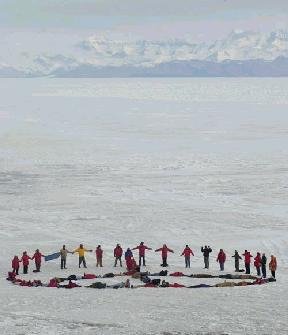
we're everywhere (peace sign at Antarctica) Posted by Hello
Weekend for Peace

It's not too late to plan to attend--- or even to plan to hold---a peace vigil or demonstration next weekend, March 18-20, which marks the beginning of the third year of the U.S. invasion and occupation of Iraq, begun with an unprovoked bombing attack two years ago. (You can find information on scheduled events plus tips on how to organize your own vigil here:
Sojourners : Meet-ups.)

One of the more insidious attacks by the cynical right has been on the very concept of peace vigils or peaceful demonstrations for human rights, civil rights and racial justice. These rich and pretend- rich yuppie GOPers like to swill their cocktails in their Washington hotel lobbies and make fun of those liberal fools who "sit around in circles holding candles and singing Kumbaya." They've been pretty successful in making the Kumbaya line a standard part of their repertoire, to show how impractical and out of touch these dopey hippie liberals are, with the additional touch of insulting the feminine, African culture and the African American religious roots of the non-violent civil rights movement.

The idea is that these phony folk singing liberals are too soft and too wimpy, not like these steely warmongers who bravely send the sons and daughters of Latinos, American Indians, African Americans and poor people in general to fight and die for their simplistic self-serving theories and grand delusions. You'll never catch one of these chicken hawks at a peace demo, nor will you find one on the front lines in Iraq or Afghanistan. They do their fighting by intimidating voters here at home, or launching guerilla warfare on the truth.

But we can't let them intimidate us, and separate us from an important and powerful expression. The peace vigil is a strong statement, because it enacts in a symbolic way the peace that it advocates. The candles and the singing are part of that symbolism and a great part of that power.

Here in the midst of a growing Dark Age, each of us holding that sliver of light and warmth is an individual statement for the future. Singing together and marching together is our collective statement for the future.

The power of these acts may not be felt immediately, as they manifestly were not when millions upon millions of people around the world demonstrated for peace and against Bushwhacker aggression before the first bombs fell two years ago. No, the circles and the candles and the singing and the marching did not prevent those bombs from falling. It may be a long while before they do. That doesn't make it as useless gesture. It works on different levels, and in different ways at different historical moments.

Even if no one sees or hears or feels the power of these acts except the children who will come together and light these lights when we are gone, then we are doing our job. We stand together for all to see, for all to hear. At the very least, we're saying we're still here.

No, peace vigils alone will not change the world. But they can help, and they help change us. People who have participated in a peace vigil do not automatically create peace, nor do they even become automatically peaceful, but they are never the same. We all need to take more steps. But we must not abandon this one.

Don't let this cynical age stop you. Maybe some people did this sort of thing in the past because it was fashionable. People do all kinds of things for all kinds of crazy reasons. But that doesn't detract from the power in this ritual, in these symbols, that we share. They may laugh at us. But these are our lights, and our songs, and this our circle, and we believe in what it says.
In other new...

"Weather or Not" at This North Coast Place.

Sunday, March 13, 2005

The Dan Rather Story

Dan Rather' s retirement from the big news show was a big news story. Part of the big news story was about the big news story he got wrong. But nearly all of those big news story about the big news story he got wrong were themselves wrong.

Bad news all around.

Dan Rather and CBS did not broadcast a false story about GW Bush's National Guard non-service. They made a technical error in one part of the story, by accepting the authenticity of a piece of paper. It was the wrong piece of paper, evidently. But what was written on the piece of paper, as far as it said anything about Bush's service, was correct and factual. The same woman who said she didn't type that particular piece of paper said she typed a piece of paper that said essentially the same thing.

The facts are correct. The story is not false. And so this become yet another politically motivated lie which the news media perpetuates until it becomes the conventional wisdom.

So the lie becomes the accepted truth. Really bad news.

Now the rightist liars have succeeded in creating contempt for the name of Dan Rather. I'm not a fan, I haven't watched the CBS Evening News for years, nor do I watch 60 Minutes. But I hope that when this subject comes up he insistently corrects the record.

Al Gore's name became a one liner of contempt, thanks to such often repeated lies as his claim that he invented the Internet. He did not ever make that claim. Have you ever seen a piece of tape of him saying it? Seen it in print? It doesn't exist. But such is politics today that even Gore jokes about this, as if he had made that claim. This is wrong. It is playing into the conscious strategy of the rabid right to create contempt for everyone and everything they oppose.

Stand your ground, Dan. Courage.