Monday, March 21, 2005

She's Ready for Her Close-up Mr. Demille
by Theron Dash

Thank God we have St. George Bush in the White House to leave orders to be awakened from a sound sleep just so he can sign that bill to save that woman's life! The woman the Democrats wanted to kill! Sayeth the multitude.

Thank God we have that woman in a vegetative state (namely Florida) and all those pious prolife demonstrators on Palm Sunday and above all the spectacle of our elected sheep slinking back to Washington for a dramatic vote to pass an unconstitutional law so we have a story that we can flog for days, sayeth CNN, Fox News and MSNBC. As NBC, CBS and ABC cryeth out, halleluiah!

And sayeth not this woman is but a tragic remnant of a consciousness, of a person, that no longer exists, with profound brain damage for more than a decade, for that would detract from the drama. Nay! Speaketh only of saving her life, sayeth the News Director. And hearing this, the network Executive smiles upon him, and sayeth this is my News Director in whom I am well pleased.

But just to be certain, the Executive from his seat upon the burning Bush pronounces these Commandments unto the media prostrate before him:

Thou shalt not refer to this woman as a political football with eyes that seem to see but seeth not.

Thou shalt not mention that by law passed in the Time of Bush and signed by him, verily just this past week a baby in Texas was torn asunder from his mother and caused to die, while his mother weepeth, because that mother had not the riches nor the health insurance to pay for heroic measures.

Thou shalt not bear true witness that this baby was black, and in the district of the Most Sanctimonious Felon, Tom DeLay. Nor that this child's name was Sun.


Thou shalt not call the Lord thy President obscene.

Thou shalt not bear true witness to the fact that the same Republicans who standeth grand , would slay the the malpractice suits of such kind as the one that is paying for this poor soul's care in Florida.

And pointeth not out that these same righteous also oppose Medicaid to pay for feeding tubes for other really poor souls, and cry out against any sane and humane health care system that profiteth them not, nor their corporate brethren and faithful lobbyists in the land of milk and honey, the land of flowing Campaign Contributions. For these truths helpeth not the ratings, they cause the lords of the ringtones to weep and gnash their portfolios. Neither do they please the priesthood of the Temple on the Hill, where they pay for the sacrifice of heathens to the lord their president and his White House.

And lo the cringing media cry out, thou are most wise! Of all the Executives, thou must be the Chief!

Now let's showeth her photo one more time, the one wherein she seemeth to smile! Heed not the pagan doctors, and their evil anti-life talk of brain damage, and the propensity to project emotion onto the now blank slate. We all love a puppet show! This horrific spectacle in Washington and the dignity of a human being now desecrated is a small price to pay for our demented righteousness, and all the sound and fury and tinkling symbols we can beam around God's sad earth.


Saturday, March 19, 2005

Get It While It's Hot

Another couple of studies support those issued in the past month or so, concluding that global heating is underway, it will be consequential, and it cannot be stopped, possibly for a century.

At the risk of remaining too far ahead on this subject, I see a new political danger. Until now, the GOPers have refused the validity of the evidence, deny the climate crisis will happen, and refuse to take steps to control greenhouse gases, let alone convert to sustainable non-harmful energy.

But now scientists are beating the drum of an oncoming crisis that can't be stopped, but must be dealt with. The emphasis is on preparing, mitigating, preventing the most harmful consequences. This is a huge change of emphasis and a huge danger.

Of course this needs to be done, as I've written earlier. But the danger is that the efforts to control emissions and switch to sustainable energy will be abandoned, because they will only make things better beyond the end of this century.

As it stands now, things will be bad. If nothing is done to stop the source of harm, in the future things are likely to be much worse. A sane policy would be to do both, and I've outlined how to approach it. For example, here. But progressives better wake up to this rapidly changing situations before GOPers realize what an opportunity they've got.

Because right now, there is an enormous opportunity for Republicans to suddenly adopt a global heating crisis is here mentality, in order to fund dikes, pipelines, chemicals and other emergency and mitigation projects, which will require even more fossil fuel energy. They will give the job to their energy corporation buddies, along with Halliburton. In a war on climate change. And we can forget about the future, and the health benefits as well as many other benefits of clean sustainable energy.

At the moment, progressives and environmentalists are stuck wholly in the mode of Kyoto greenhouse gases treaties and warning of the crisis that is already here. It's much too tempting a situation for GOPers, especially if Democrats, still in denial, are caught flatfooted.

Global warming inevitable, stopping gas emission won?t help

Friday, March 18, 2005

Comedy is Too Easy

Jon Stewart is a smart and talented guy, but his job is way too easy. Make fun of the news? How do you avoid it?

For comedians every news day is a holiday, but some are more St. Patricks than others. Thursday gave us the 51-49 Senate vote in favor of drilling for oil in the Alaska wilderness preserve. Besides the expected gaggle of GOPers, the measure passed thanks to two Democrats: both Senators from that other state of wilderness and beauty and non-continguity: Hawaii. Can you even imagine the outrage of a proposal for off-shore drilling in Hawaii? But it might be worth it, just for those two guys.

It also gave us a provocative new study purporting to figure that all these obese kids aren't going to live so long, and therefore the U.S. life expectancy will decline for the first time since, maybe, Fox News. But the way that some papers slugged this story was as the solution to the Social Security crisis. Because people will die five years earlier, think of all the money Social Security will save. Oh happy day! (For a more balanced view, the link below.)

Jon?

Obesity will cut American life span by 2 to 5 years: report
In other New...

A review of Democracy and Populism by John Lukacs at Books in Heat.

"Heroes" behind Trek at Soul of Star Trek.

Monday, March 14, 2005


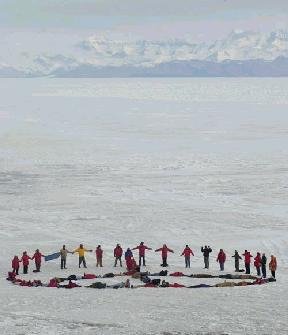
we're everywhere (peace sign at Antarctica) Posted by Hello
Weekend for Peace

It's not too late to plan to attend--- or even to plan to hold---a peace vigil or demonstration next weekend, March 18-20, which marks the beginning of the third year of the U.S. invasion and occupation of Iraq, begun with an unprovoked bombing attack two years ago. (You can find information on scheduled events plus tips on how to organize your own vigil here:
Sojourners : Meet-ups.)

One of the more insidious attacks by the cynical right has been on the very concept of peace vigils or peaceful demonstrations for human rights, civil rights and racial justice. These rich and pretend- rich yuppie GOPers like to swill their cocktails in their Washington hotel lobbies and make fun of those liberal fools who "sit around in circles holding candles and singing Kumbaya." They've been pretty successful in making the Kumbaya line a standard part of their repertoire, to show how impractical and out of touch these dopey hippie liberals are, with the additional touch of insulting the feminine, African culture and the African American religious roots of the non-violent civil rights movement.

The idea is that these phony folk singing liberals are too soft and too wimpy, not like these steely warmongers who bravely send the sons and daughters of Latinos, American Indians, African Americans and poor people in general to fight and die for their simplistic self-serving theories and grand delusions. You'll never catch one of these chicken hawks at a peace demo, nor will you find one on the front lines in Iraq or Afghanistan. They do their fighting by intimidating voters here at home, or launching guerilla warfare on the truth.

But we can't let them intimidate us, and separate us from an important and powerful expression. The peace vigil is a strong statement, because it enacts in a symbolic way the peace that it advocates. The candles and the singing are part of that symbolism and a great part of that power.

Here in the midst of a growing Dark Age, each of us holding that sliver of light and warmth is an individual statement for the future. Singing together and marching together is our collective statement for the future.

The power of these acts may not be felt immediately, as they manifestly were not when millions upon millions of people around the world demonstrated for peace and against Bushwhacker aggression before the first bombs fell two years ago. No, the circles and the candles and the singing and the marching did not prevent those bombs from falling. It may be a long while before they do. That doesn't make it as useless gesture. It works on different levels, and in different ways at different historical moments.

Even if no one sees or hears or feels the power of these acts except the children who will come together and light these lights when we are gone, then we are doing our job. We stand together for all to see, for all to hear. At the very least, we're saying we're still here.

No, peace vigils alone will not change the world. But they can help, and they help change us. People who have participated in a peace vigil do not automatically create peace, nor do they even become automatically peaceful, but they are never the same. We all need to take more steps. But we must not abandon this one.

Don't let this cynical age stop you. Maybe some people did this sort of thing in the past because it was fashionable. People do all kinds of things for all kinds of crazy reasons. But that doesn't detract from the power in this ritual, in these symbols, that we share. They may laugh at us. But these are our lights, and our songs, and this our circle, and we believe in what it says.
In other new...

"Weather or Not" at This North Coast Place.

Sunday, March 13, 2005

The Dan Rather Story

Dan Rather' s retirement from the big news show was a big news story. Part of the big news story was about the big news story he got wrong. But nearly all of those big news story about the big news story he got wrong were themselves wrong.

Bad news all around.

Dan Rather and CBS did not broadcast a false story about GW Bush's National Guard non-service. They made a technical error in one part of the story, by accepting the authenticity of a piece of paper. It was the wrong piece of paper, evidently. But what was written on the piece of paper, as far as it said anything about Bush's service, was correct and factual. The same woman who said she didn't type that particular piece of paper said she typed a piece of paper that said essentially the same thing.

The facts are correct. The story is not false. And so this become yet another politically motivated lie which the news media perpetuates until it becomes the conventional wisdom.

So the lie becomes the accepted truth. Really bad news.

Now the rightist liars have succeeded in creating contempt for the name of Dan Rather. I'm not a fan, I haven't watched the CBS Evening News for years, nor do I watch 60 Minutes. But I hope that when this subject comes up he insistently corrects the record.

Al Gore's name became a one liner of contempt, thanks to such often repeated lies as his claim that he invented the Internet. He did not ever make that claim. Have you ever seen a piece of tape of him saying it? Seen it in print? It doesn't exist. But such is politics today that even Gore jokes about this, as if he had made that claim. This is wrong. It is playing into the conscious strategy of the rabid right to create contempt for everyone and everything they oppose.

Stand your ground, Dan. Courage.

Saturday, March 12, 2005

In Other New...

There's a new series of old previously web- unavailable articles, where you can stroll down the memory lane of the arts in the 1980s (Dash Brothers hint: it's still the 1980s) over at kowincidence.

Thursday, March 10, 2005

Blood

So bloodthirsty are our appalling leaders in Washington that the Bushworlders have taken this entire country out of International Court agreements because groups here opposed to the death penalty are using these agreements against it, since few other civilized countries on the face of the planet still insist on legal killing.

The death penalty matters more to them than international relatons and international justice, which protects Americans abroad and the rights of foreigners here. They are scared to death of actual justice for their atrocities on foreign soil, and so willing to let the atrocities of others continue without international standards or sanctions. Another predictably shameless and shameful day for the rich thugs that run our government.

Top News Article Reuters.com

Wednesday, March 09, 2005

Progressively Lost

From "No More Mr. Nice Blog":

"We simply don't have the Right's message machine. A bit of what happens on the Right is purely grassroots -- I'm thinking of the work of Christian conservatives -- but right-wing activism packs a punch only because of big money, from self-interested corporations and scheming think-tank-funding billionaires. Big money shapes the message and gets it out there. That, in turn, keeps a much larger percentage of ordinary conservative Americans pumped up and versed on talking points than we can muster on the other side."

But it's more than this. The Reds have access to more money, but there is money on the Blue side as well---it just isn't being spent in the same way. The rabid right recruits early and keeps people on their payroll. Kids with talent get scholarships, fellowships, jobs with real influence, and access to the right's political leaders. They take care of their own.

But it's one of the unpleasant ironies that while the rightists carry on about individualism, they are better at supporting each other, while the left with all its solidarity rhetoric, has little or no consciousness about making sure its people are supported, and that means with jobs, fellowships, institutes, etc. Even the rightist bloggers are better at supporting each other.

Back when they were big enough to do so, labor unions performed this function of spotting talent and finding a place for it for the Democratic party. But it seems that left leaning think tanks etc. have remained exclusive and elitist. The left would rather discuss their minute differences and plug their narrow issues than take care of their own.

When told that a program under consideration for the New Deal would benefit people in the long term, FDR advisor Harry Hopkins retorted, "People don't eat in the long term. They eat every day." While we work for a better future for all, we had better be aware of what's needed in the present.

Tuesday, March 08, 2005

Faith Based Minimum Wage

More people with more money to spend creates more economic activity. But enough of that reality based nonsense. Listen to the faith-based answer:

"When you raise the minimum wage, you price workers out of the market," said Senator John E. Sununu, a New Hampshire Republican. "That's the economic reality."

You need to have faith in this economic reality because Republicans have been saying it at least since they opposed raising the minimum wage to $1.25 in 1961, and they have always been wrong.

But to believe that providing a floor of seven bucks an hour instead of five for the people who do the shit work nobody else wants to do will ruin the economy requires a lot less faith than what is needed to give huge tax cuts to the extremely wealthy, believing it will benefit the economy even as it raises the deficit beyond the stratosphere, thus already impoverishing the grandchildren some of you youngins have faith you'll have.

Read it and weep: the Dark Lord Santorum leads the sanctimonius GOPers in maintaining virtual slavery.

Boston.com / News / Nation / Washington / Minimum wage hikes die in Senate

Monday, March 07, 2005

In other new...

"Sell the Children" at Shopopolis. A review of Homeland , a portrait of post-9/11 America by Dale Maharidge at Books in Heat.
Photo portfolio on North Coast arts at North Coast Texts.


And today's outrage, while some want to push the definition of human life back to the pre-embryonic, there seems to be a whole lot of difficulty taking care of millions of children already born, even when it could be done at a fraction of the cost of their political action committees' budgets...

New Scientist Breaking News - Push to save three million babies every year

Wednesday, March 02, 2005


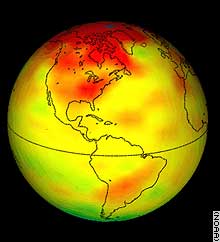
What happens when warm becomes hot? Posted by Hello
Reframing the Climate Crisis 1: Don't Call It Global Warming

Since this is now an archival matter, I've changed the order of the three parts of this series as it initially appeared. Now it follows one, two, three, from the top down.

The climate changed dramatically last week.

While most nations solemnly bound themselves to the Kyoto Accords, scientists announced the most definitive proof yet that global heating is well underway, caused by human-sent CO2. "The debate is over," said one scientist, "at least for rational people."

It is now clearer than ever that the climate crisis has begun. Eventually it will dominate world politics for the next fifty years. It is already moving quickly to the forefront of European concerns. Two-thirds of British Parliament members polled believe it is more important than terrorism.

But though Americans are more conscious of it than politicians seem to realize, there is no national sense of urgency. Now is the time to think very carefully about how to frame the issue constructively. This is the first in a short series exploring approaches to that question.

Doubters say the world isn't heating up significantly, and even if it is, it's a transitory natural phenomenon, and the models predicting climate change because of fossil fuels are alarmist speculation.

But evidence was piled upon evidence at the American Association of Scientists annual meeting last week that global heating is having alarming effects on ocean water temperature, vegetation and wildlife, and human life.

And then the final word: a study of ocean temperatures in the last 40 years showed a rise that only greenhouse gas emissions can explain.

"We were stunned by the similarities between the observations that have been recorded at sea worldwide and the models that climatologists made," said Tim Barnett of the University of California's Scripps Institution of Oceanography. "The debate is over, at least for rational people."

Of course, the debate is not over politically. In many ways it has not really begun. But the problem of how to move this issue up on the list of political priorities has also changed. It's gotten more complicated.

Until recently, the idea was to get people motivated to demand change that would lessen the probability that the climate crisis would cause serious problems in the future. But now we are pretty sure they are going to be serious problems in the near future, no matter what we do to try and stop them. For example, those same scientists from Scripps said last week that no matter what we do, some parts of the world---including the western U.S., China and South America---will experience water shortages and other crises over the next 20 years.

So now there are two sets of actions that need to be taken simultaneously. One is to prepare for dealing with crises that result from global heating. The other is to create change that will lessen the impact of global heating in the future---a future that few of us will see, but our children and grandchildren may.

Still, the first task remains: generating a sense of urgency, especially among Americans and their political representatives. How the issue is framed must reflect the twin nature of the necessary actions, of anticipating emergencies in the near future, and of preventive action for the farther future.

Most polls have consistently shown that around two-thirds of Americans believe in "global warming" and support efforts to address it. Why is this then not an issue every ambitious politician seizes?

I'd love to hear Al Gore answer that question, even on deep background. It's clear from past experience that leadership is essential. But because the necessary actions involve a different way of thinking, and some apparent sacrifice, it is difficult to sustain leadership when opponents can exploit yearnings for the ecological free lunch. During the energy crisis of the 1970s, President Jimmy Carter was successful in urging Americans to cut back on wasteful uses of energy, and the growth in CO2 levels actually declined for years afterwards. But high inflation and the Iran hostages added to his woes, and Republicans under Reagan were able to offer a more self-indulgent vision, which it took eight years of a Democrat in the White House to pay for.

Americans are willing to pay for what they consider an urgent threat. Violent threat countered by warfare is the easiest to understand, hence the budget-busting wars on terror and in Iraq. They are however accompanied by the illusion of no new taxes, and therefore no apparent sacrifice.

So the first task in reframing I believe is still to encourage a sense of urgency, of what someone called an "emotional consensus" on the climate crisis.

Don't Call It Global Warming

The simplest way to begin this reframing is with nomenclature. It has been driven by the vocabulary of science, which was initially appropriate, because scientists have been working on the problem since some first anticipated the effects of fossil fuels on our atmosphere back at least as far as the 1960s.

At first it was called "the Greenhouse Effect," which is the kind of metaphor scientists employ: familiar and relatively accurate to what they theorize is happening. Later the description "global warming" became the media term. More recently, "climate change" has joined or replaced this term in the media. All of these terms are reasonably descriptive, while they reflect the precision of science. But none of them expresses urgency.

Not only are these words non-threatening, they have comforting connotations.W arming conveys really nice things. It's warm and cuddly. Happiness is a warm puppy. Listen to the warm. Can I warm up that coffee? Let's give a warm welcome to...

It is counter-intuitive to think of "warming" as a bad thing. Even as a negative it is, at best, lukewarm. So who can afraid of global warming?

Nothing about it is urgent. You may urgently desire a warm coat on a cold day, but people don't feel too warm. They feel too hot. Then it's urgent.

In fact all of the terms commonly used have more good connotations than bad. "Climate change" is neutral: change can be good or bad. When you're cold or it's stormy, a change in the climate is welcome. People get on airplanes to go find climate change.

The greenhouse effect was scientifically elegant, but again it is at best abstract and definitely not scary. To most people, greenhouses are good. Flowers grow in them. Flowers are pretty. The greenhouse effect sounds like it could make the world prettier.

It is time to turn up the heat on the terminology. Instead of "climate change," it would be helpful to refer to it as THE CLIMATE CRISIS. Ross Gelbspan used it as the subtitle of his book, "The Heat Is On: The Climate Crisis, the Cover-up, the Prescription. Crisis projects urgency.

Gelbspan also uses "heat" rather than "warming." Don't say global warming, say GLOBAL HEATING. As a word, heating is at least potentially threatening in a way that warming isn't.

These may not be the best terms, but they seem to be the easiest, since they are variations on terms that everyone already knows. They will gain power only by repetition. They carry more of a sense of urgency, and that is a necessary precondition to other reframing. The first task is to get attention and focus.

I don't want to oversell this suggestion. It isn't a panacea. It is a possible beginning. It may turn out to be important, because politicians may try to isolate catastrophes and threats that are products of the climate crisis, and so the greater problem is not addressed with the necessary comprehensiveness and urgency. The recent scary weather in Los Angeles can be positioned as Mother Nature acting up again, or God's wrath on Hollywood, but think of the difference in response if it is said to be a result of global heating, versus global warming.

Polls show that Americans are disposed to believe that weather phenomenon they can't help but notice are products of the climate crisis. But the nomenclature gives them no sense of urgency. It's not that these small changes in nomenclature are absolutely necessary. But they could be powerful.

Tuesday, March 01, 2005

In other New...

Account of a talk by Star Trek visual effects director Dan Curry (illustrated!)
is now at Soul of Star Trek.

Account of the 2005 Indian Island Vigil in Eureka CA is at This North Coast Place.

tipped point Posted by Hello
We Are All In This Together: Reframing the Climate Crisis 2

The premise of this post, as the previous one, is that the climate crisis is likely to dominate world politics for the next 50 years, beginning quite soon. It is moving very quickly towards becoming the dominant issue in the United Kingdom and in Europe as a whole. Japan and other nations in Asia and Africa are taking it very seriously, as is the UN.

The United States and its major media, and much of its alternative media, including blogs blue and red, are virtually alone in their ignorance and denial.

In that first part, I outlined the difficulty of reframing an issue with such unique properties. I suggested first steps in reframing in order to encourage a sense of urgency. In this part, I'll try to point out how to reframe the climate crisis in ways that simultaneously reframe the purpose of the Democratic Party and the progressive or liberal agenda.

The climate crisis could conceivably go on being unrecognized for some time, as we try to cope with its individual manifestations, from weather-related emergencies to disease infestations and epidemics. It is even possible that global heating droughts will lead to severe fresh water shortages, which will lead to severe conflicts and even war, without the ultimate cause ever being made clear. In fact, this is pretty likely, as long as we continue with politics as usual.

However, there will likely be weather-related manifestations that people will understand as related to the climate crisis. Polls show that a large majority of Americans-up to 70%---believe that global heating is real. Once they believe that the climate is an urgent crisis, they are going to need to know what to do about it.

It is imperative that our political leaders begin talking about the climate crisis in terms of how to deal with it. Not just in terms of programs or funding, but first of all in terms of what it means, and what it challenges us to do.

The facts can be outlined very simply. The climate crisis will create serious problems very soon, and there is nothing we can do to stop these effects. We must address the consequences, hopefully in the more predictable cases by anticipating them and taking preventive action. Admit that there will be problems, try to anticipate them, but act quickly and with a sure hand when and where they occur. That's the first set of challenges.

What ideas will help us cope with the effects of the climate crisis in our lifetime? Certainly the renewed attention to science and to our international partners that John Kerry talked about in his campaign will be essential. But the climate crisis also provides the opportunity to re-state in suddenly very meaningful terms the basis of our political beliefs. In fact, the climate crisis demands that we respond at this level, because it's going to take a broad emotional consensus for us to manage this perilous time.

The climate crisis will manifest in different ways in different places in the world, at different times. Problems common to several manifestations will emerge---the lack of fresh water, for instance. There will be likely be food shortages in some places, catastrophic weather events, a severe change in climate resulting in many more heat or cold related deaths, and so on. And there will be less quantifiable but no less devastating changes, as local ecologies change, and the vegetation and wildlife, the landscape itself becomes unfamiliar. We are seeing this already in the Arctic and northern Alaska, where hotter oceans devastate the polar bear and whale population, ice is melting and the cultures as well as the livelihood of Native peoples there are under extreme stress. It is happening with rapidity that surprises even climate scientists.

What does all this mean? Basically, that we are all vulnerable. Although some places will feel direct effects as catastrophes, our planet is so interdependent at virtually all levels, that we will all be affected. Moreover, the whole web of interrelationships will be affected.

That is the message of life we've been missing. Our individual liberties and prosperity depend on the indulgence of the whole, and on the basic social bargain that since everybody may need help at some time, everybody needs to be ready and willing to lend a hand.

This relationship of individual freedom to a sense that we are all in this together is basic to progressive and liberal thought, and to the Democratic party. Equality before the law, regardless of race, gender or class, is one expression of this. Economic and environmental justice are other expressions. Compassion is the ethic that emerges from it, but compassion and empathy are basic to human survival, because none of us survives alone. It's been that way for a very long time.

That is the frame: we are all in this together. It is recognized in indigenous and ancient cultures all over the world, which have evolved systems and customs of exchange, of helping neighbors, of hospitality to strangers. We see its resurgence when something dramatic catches our attention, like the Asian tsunami or some particular kidnapped child---something that momentarily seizes imagination and cuts through the numb busyness of our lives. It awakens the empathy genes, or stimulates the empathy circuits, however you want to explain it.

In order for each of us to pursue our differences and our destinies, we have to be able to depend on each other. It's as elemental as the family. It's as profound as what binds the most cohesive military unit.

In our individualist culture, it requires a little imagination. Someday I will be old. I was once young. I am well-fed, but someday I could be hungry and desperate. I am healthy but someday I will be sick. I was born in a privileged race in a privileged place, but it could have been otherwise and I would not be less worthy. I am old and weak, but I know things; they are young and strong, but they don't know what would make things better. We can help each other.

We are all in this together. It was the basis for FDR's response to the Great Depression, and the Marshall Plan and the GI Bill of Rights after World War II, and the Civil Rights Movement, Medicare and the War on Poverty in the 1960s. Certainly they all had other less noble political objectives, and messiness in the details. But we evolved some greater recognition of common self-interest: that we are all in this together.

We will need leaders who will stand up and re-state this fundamental truth, to make it central to our national purpose again. The United States can use its vast economic power, its science and technology, to help the rest of the world through the short term crises they may face. The science and technology of wringing fresh water from seawater and wastewater is one example.

We can learn much from what Europeans have learned from the different paths they've taken. We can learn much from ancient cultures, some of which we are usually in the process of destroying.

We will need to apply these old lessons and expand their purview. The definition of "we" must expand. In a sense we might call social, with political implications, we will need to evolve some more.

We are all in this together. There will be states and regions in the U.S. that are harder hit than others, and the kind of callousness we now exhibit in our failure to have a decent health care system will not do much for our ability to get through the climate crisis, even in our own country, as well as our own continent and our hemisphere.

Of course none of this tells us specifically what we must do. It doesn't automatically illuminate the best policies, and it certainly doesn't predict exactly what manifestations we will face. But people are working on those subjects. They are figuring, quantifying, extrapolating and designing solutions. They are experimenting, advocating, producing. They are testing and stockpiling the knowledge we will require to choose from, as events call forth the need.

But we have to be ready to consider and choose, and know why we are choosing. I believe we need a framework. Maybe this isn't exactly it, but it seems close enough to restate: we are all in this together.

The second set of challenges will be to do what needs to be done to restore the earth's climate and its self-regulating systems so that human civilization can continue after our generations are gone, and the world belongs to our grandchildren and the generations that follow. Suggestions for reframing the climate crisis issue for that purpose will be the subject of the next part in this series.

Sunday, February 27, 2005


remember the future Posted by Hello
Remember the Future: Reframing the Climate Crisis 3

To work together to protect against inevitable effects of the climate crisis requires an expansion of the concept of "we" to include everyone on the planet, and the planet itself. But to dedicate ourselves to changes that may not benefit us, that may make things better for generations who will live after we are gone, requires another expansion of "we." That's why the climate crisis is such a test of human capacities, and the capacities of our societies. We are going to have to think and feel more comprehensively, taking into account not only the whole world now, but the whole world in the future.

A crisis caused by climate is not in itself unprecedented, at least in specific localities, but our situation may well be. Because we know more or less what is coming, and more or less what we could conceivably do, even what we should do, to reverse the process that we unthinkingly began: killing the ability of our planet to sustain our lives.

The possible outcomes of the climate crisis are of course complex, but they come down to a few basic alternatives: Human civilization may weather the crisis with comparatively minor catastrophes, while much of the rest of life on earth reshuffles: some species die off, others expand, and eventually the ecosphere rebounds and continues to flourish.

Another possibility is that human civilization may not survive, either at all or in a continuously evolving way. This is likely to be coterminous with a vastly changed flora and fauna, and very probably a marked and dangerous decrease in biological diversity.

At the end of these possibilities is the end of civilization, the end of human beings on the planet, and the end of "life as we know it", although some forms of life may continue. Even a totally dead planet as a result of the continuing alteration of the atmosphere, though that might take many many years, is not outside the realm of possibility either.

The predictions based on data and trends are not conclusive, and may never be. But the best case scenario is for imminent changes that will adversely affect portions of the planet, very probably to an extent we have not experienced in many centuries. And there are climate models that predict conditions that would mean the end of planetary life as we know it, by the end of the next century.

So what do we do about all of that? Won't we have our hands full just coping with each catastrophe as it happens?

Our society is biased towards not only the individual and the nation-state, but towards the present. Still, we are complex beings, with complex cultures, that have the equivalent of recessive traits. Much of our present-centeredness is the result of this historically unusual period of prosperity in this place, together with the persuasive mechanisms our most powerful institutions and media use on us. But we also have half-buried traditions and untried potentials. And sometimes when we remember the past, we remember the future.

This is the frame I suggest: responsibility for the future. It is deep in American history, and expressed most eloquently in the Great Law of the Haudenosaunee (Mohawk and Iroquois peoples): "In every deliberation we must consider the impact on the seventh generation to come."

We have a responsibility to the future, which means that we must find ways to alter our behavior today, including how we get and use our energy. We may not live to see the ultimate impact of these efforts on the climate crisis itself, but we do it for generations to come.

Our leaders will have to explain that for us, we passed the tipping point years ago, and we must deal with the effects of global heating. But the time lag between cause and effect can benefit future generations, if we work hard to change our behavior now. We will be doing what all good parents do, sacrificing for their children and grandchildren, unto the seventh generation to come.

But let's bring it back to today's political terms. The future used to be a concept the Democrats owned. FDR's New Deal, Truman and the Marshall Plan, JFK's New Frontier and the Apollo space program, and LBJ's Great Society, Clinton's bridge to the 21st century, defined future-oriented ideas and policies.

But now, there is only one book on the best-seller list that emphasizes the future: Winning the Future by Newt Gingrich. The Bushoids' proposals for new manned lunar and Mars programs, as insidious as they might be, are further evidence that Republicans not only own the Apocalypse and the Rapture, they are taking possession of the future.

But the greatest challenge to the future is the Climate Crisis, which the Bushwhackers deny is real. It will be one of the great challenges humankind has ever faced, and it's time for Democrats to step up and take back the future.

At this time, when we are still prosperous and still feel basically safe, if a little uneasy about the weather, it requires imagination to grasp how powerful these simple messages can be in times of stress and chaos. It is important that we concentrate on them, because there are other equally simple and powerful messages that will only destroy us. After 9-11, our leaders could have guided us in a different and better direction. Instead they guided us into a morass of illusion, fear and nationalistic xenophobia. If that happens again in response to the climate crisis, we will be lost. We may not survive the climate crisis, as a civilization, no matter what we do. But if we take the wrong course, we will make certain that civilization does not survive.

(There's a longer version of this essay here.)