Friday, February 25, 2005

Watching the Watchers Watch

We got one of those invisible counters, that lets us know how many visitors there are to the site, and generally where they are. We've had visitors here over the past few weeks from Canada, Mexico, Singapore, Malaysia and the Netherlands as well as the U.S.

We also had one visitor whose address indicated the U.S. Justice Department, linked to American Dash from a "No to Gonzales" site which lists the "Indy 500" blogs that signed a petition saying, well, no to Gonzales as Attorney General.

While we welcome readers from wherever they are, we want anyone watching officially to know that we are watching them watching us. And we'll be telling others about it.
Feedback

We posted a version of our post here concerning the CA single payer universal health care plan on Daily Kos, which just won a Koufax Award (for leftie blogs; Sandy Koufax, get it?) as best blog.

There were nearly 40 comments and the post made the Reccomended List for part of the afternoon. (Unless a "diary" post makes the Rec list, it is apt to slip off the front page list of new posts, and hence the attention of browsers, after fifteen minutes or so.)

But of the 40 comments, there were a bunch that constituted a kind of chat room dialogue on California politics and bilingual education. Yeah, I don't get it either.

Then there were several saying flatly that the bill has no chance of passing, or getting past Arnold's veto. As if that was supposed to end the discussion. Others quibbled over provisions, though some of these showed evidence of skimming the text, which is hard to fault because we do it all the time.

One of the few relevant comments, and the one that got the most attention (highest ratings from most people) was this one, from "Wu Ming"

this is an opportunity to accomplish a lot of things:
divide businesses, who do not want to pay skyrocketing rates for their employees' insurance, from insurance companies who benefit from the status quo.


force ahnold and the republicans to come out against health care for everyone, and use it to paint them as enemies of real family values and the common good.

start to make a case in the public eye for how rediculously wasteful the current system is, and how much more affordable a single-payer plan would be. the controversy offers a window to make a counter-case, but only to those with a clear plan that could cut through the rhetoric of a hostile media.

it grabs the political momentum, and makes the passage of even a watered-down plan after negotiation (which would be a hell of an improvement over the current disaster of a health-care system) much more likely.

if successful, it not only provides us with a successful model to take to the national level in 2006 or 2008 or whenever we take congress back, but would also go a long way towards insuring a large chunk of the nation's uninsured here in california.

there is no downside to this plan if fought for with intensity and smart rhetoric, and we ought to think seriously about taking it to a ballot initiative if ahnold tries to shoot it down.


Reading and writing on Daily Kos and My DD sites is educational in many ways. On the positive side, comments contribute links to new relevant information, offer good criticism and alternatives, and personal experiences pertinent to the topic. But on the less positive side, there are fairly narrow views, rampant cynicism and negativity. Hardly a surprise, but a reminder of how hard it is to get things done, even when people are supposedly on the same side.

In the next few days we will post a series on Reframing the Climate Crisis. Several installments have been posted on Kos to massive indifference so far. But then we are dealing in some sense with prophesy, and you know what they say about prophets in their own time.

As for these two issues, if the Dash Brothers happened to win the lottery and we could spend a couple of days a week say on our "causes," we would select universal health care and the climate crisis. And the skills of peace.

We would specifically work for universal health care plans on the state level, where they have a chance to be openly debated and even enacted. Nothing like that will happen on the federal level until 2009.

We would specifically work within the Apollo Alliance on climate change issues. Apollo is the best program we've seen for combining new energy infrastructure with new technological and manufacturing industries in the U.S. It's at least a place where environmentalists and labor can meet.

This would be when we weren't exploring for the best espresso and pastries in Torino.

Thursday, February 24, 2005

In Other New...

"Mall Captain and the World of Tomorrow" at Shopopolis.

It's that time again... Posted by Hello
Lobby Days and the March March

Peace groups are asking constituents to contact their members of Congress this week, as most come home during the current recess, to advocate ending the Iraq war and bring the troops home. More information here:
Iraq Next Steps: Building Unity on U.S. Policy - FCNL

Efforts are also well underway to organize marches and peace vigils on or around the anniversary of the start of the Iraq war. There's information on various efforts from United for Peace.

Sojourner's magazine provides a couple of useful services: you can search for a scheduled demonstration near you at this site, where you will also find ideas on organizing a peace vigil where you live.

Tuesday, February 22, 2005

Failing Health: California Prescription


This Wednesday, February 23, California state Senator Sheila James Kuehl will introduce a bill to make California the first state in the U.S. to offer universal health care through a single-payer system.

This is the third time she has introduced similar legislation, and this time it has a fighting chance. California has often been in the forefront of changes that soon swept the nation. Help Senator Kuehl set a precedent, to address the single greatest humanitarian crisis in America, with the greatest economic and social consequences.

For those near enough to Sacramento, there will be a rally beginning at noon on Wednesday, February 23, on the south steps outside the Capitol.

Californians, contact your state senator and representative to let them know that you support SB 921, California Health Insurance Reliability Act of 2005.

Everyone can write a letter of support to Senator Kuehl. Her address:
Senator Sheila Kuehl
State Capitol, Room 4032
Sacramento, CA 95814
Fax: (916) 324-4823

Everyone can contribute money and join the organization Health Care for All which supports the bill, through the website.

The Need

Health care in America is in terminal condition. Most people need only to look at their own lives and experiences to know this. How many have seen loved ones languishing on a gurney in the halls of overcrowded hospitals, where the bills are thousands of dollars a day? How many have had treatments disallowed by corporate HMOs, who moan about low revenues while they make billion dollar acquisitions? How many patients have seen their physicians quit taking insurance because of low payments or excessive bureaucracy, or even get out of medicine altogether? How many are paying more for less coverage, or have been brutally cut off by their HMOs?

How many businesses are struggling because of high health care costs for employees? How many have lost everything to pay medical bills their insurance didn't cover? And how many face pain and death because health care providers won't even treat them because they are uninsured or have inadequate insurance?

Anecdotal evidence and personal stories are backed up by facts. As noted here earlier, a Harvard University study found that illness and medical bills cause about half of all bankruptcies in the United States, an increase of more than 23 times the rate in 1981. Most of the 2.2 million Americans who file for bankruptcy for these reasons start out with health insurance. Most were middle class workers who simply got sick.

"I think it's a societal failure to have people facing bankruptcy over health care," said Dr. Alan Glaseroff, chief medical officer for the Humboldt-Del Norte Independent Practice Association in CA. "No other developed nation has that."

A Boston University study that finds fully half of the nearly $1.9 trillion spent on health care is unnecessary waste, paying for nothing more than excessively high profits, over-the-top drug and hospital prices, unnecessary administrative costs mandated by insurance companies, plus a healthy dollop of fraud and theft.

The fact is that health care and health insurance costs are dragging down businesses, crippling state and local governments, and ruining families---and still millions go without needed health care in the richest nation in world history.

THE BILL

Highlights of the plan, quoting from the Kuehl fact sheet:

"The Health Care for All Californians Act would provide health insurance coverage to all Californians through a single insurance plan offered by the State of California and would control the growth of health care spending through a simplified administrative structure, consolidated purchasing and statewide health planning."

This is universal coverage in every sense of the word: every California resident is covered--- for everything (except elective cosmetic surgeries.) Patients choose their primary care physicians, and every health care provider participates.

So how is this paid for?
"THE PLAN INVOLVES NO NEW SPENDING ON HEALTH CARE. The system will be financed by combining all federal, state and county monies already spent on health care with affordable, broad-based, earmarked state health care taxes that would replace insurance premiums. There are no co-pays or deductibles for at least the first two years. All monies to be spent on health care would be consolidated into a State Health Fund that is established in the California Treasury."

Administrative costs will be limited to 5%, and "Reimbursements will be risk adjusted to ensure that budgets cover the true costs of care." This is very important. Administrative costs of insurers and health care providers are skyrocketing. In particular they are much higher in the U.S. than other industrialized nations. That's ADMINISTRATIVE costs, not the cost of delivering care or new technology. Similarly, the costs of the same prescription drugs are higher in the U.S. than elsewhere.

"The system would be governed by a state elected health care commissioner who would head the California Health Care Agency. This agency would be assembled through the consolidation of the existing healthcare agencies." So: less private insurance bureaucracy, and no net increase in state bureaucracy.

How can universal health care possibly be affordable? Here's what this plan says:

By using state bulk purchasing power, "we anticipate a 40% to 50% decrease" in prices of prescription drugs. Bulk purchasing could save the state $4 billion, and patients will still have no co-pays. By extending primary and preventive care to everyone, some $3.5 billion to $6 billion a year could be saved from the costs of unnecessary emergency room visits and hospital stays made unnecessary by preventive care.

WHY THIS BILL WILL WORK

A study already exists showing this approach will work. The Lewin Report finds that this program will reduce total health spending in California by $8 billion in the first year, and will save some $344 billion that would otherwise be spent without this plan by 2015. The Lewin Report is viewable at Health Care For All.

A good summary of the bill, the study and the bill's prospects by SF Chronicle business columnist David Lazurus.

WHY THIS BILL HAS A CHANCE

The idea of universal health care coverage was very popular when President Clinton proposed it, and his bill was widely expected to pass, until the opposition funded by health insurers kicked in. But today, after nearly a decade of corporate HMO dominance, there is much wider recognition among physicians and even some insurers that the health care system is failing. The argument that gob'ment health care will create immense bureaucracies can elicit only horselaughs today, when doctors and hospitals are swamped with paperwork and constantly deal with interference from insurance companies in their decisions on care.

Business owners who might otherwise be skeptical can't help but notice that health care insurance costs are becoming a heavy burden. Small businesses struggle to stay afloat because of these costs, while large companies find they can't compete internationally because of the income they must devote to health insurance. This plan, says the Lewin study, is likely to save virtually all California businesses money.

Meanwhile, this bill has some carrots. It claims that the pharmaceutical industry won't lose money on it; the revenue lost by bulk purchasing will be made up with sheer numbers of patients, for 10 million Californians who have no prescription drug benefits now will be covered.
Hospitals are well aware of the drain on their income in the emergency room, where people without insurance show up for all their health care. The plan offers at least the possibility of a way out of the chaos of inpatient care in overcrowded, understaffed hospitals (the subject of this column by Jon Carroll in the San Francisco Chronicle.

As for the argument that government can't afford this, the truth is that government is paying billions without bulk savings or cost containment. All levels of government face the consequences of more than 6 million Californians who lacked health care coverage at some point in 2001. The burden that doesn't fall on the state, often falls on local governments. Ruehl estimates state and local governments would save $43 billion in the first ten years under her plan.

Ruehl argues that California can't afford NOT to enact universal health care. Others who are disgusted and frazzled with the current system may be willing to take a chance even if they aren't so sure this plan will work. The fears over rationing of care, or inadequate quality,become problems to address within the single payer system, not reasons to vote against it. Give health a chance! For millions of Californians must ask, how can single-payer universal health care be worse than the current system?

Californians are looking for a solution. A ballot measure mandating employers to provide health care coverage failed only narrowly, despite well-funded opposition. But had it passed, it would not be the solution. Even worse is a bill currently being offered that requires that every employee in the state buy health insurance in the current system, which would only transform chaos into punitive madness.

This single payer system is much fairer, and will save Californians money. Families with under $150,000 in annual income would, on average, see savings ranging between $600 and $3,000 per family under the program in 2006. Seniors could save an average of $1100 a year per household.

It's no wonder that this bill is endorsed by the American Medical Student Association, American Nurses Association, California Association of Public Hospitals and Health Systems, the
California Nurses Association and California Mental Health Association, as well as the League of Women Voters, many Democratic and Green Party organizations, labor unions, and organizations representing women and elders.

Clearly the issue of universal health care is not going to be debated in the U.S. Congress anytime soon. In California there is a chance to get the issues aired, perhaps even to force the Governor to take a stand and sign or veto this bill, and who knows? If the people are clear about what they want, a single payer plan for health care covering everyone in California could actually happen. And if it happens in California...
In Other New...

New posts at This North Coast Place and Soul of Star Trek.

Morgan's story "Blue States Highways/Red States Run" headlines his blog at Morgan Dash Unbound.

Sunday, February 20, 2005


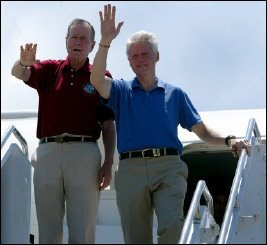
On their "non-partisan" tsunami relief tour, that's George Bush in RED and Bill Clinton in BLUE... Posted by Hello
Sunday Sermon: The Next Fifty Years

by Phineas Dash

I was asked for my views on what I believe are the most important issues in science and technology. Here they are. Because I define importance in terms of the future, I offer a very broad outline of science and technology of the next 50 years.

The next 50 years will be critical years for humanity. Throughout the twentieth century, industrial nations created monstrous technologies of destruction. Many of these were deliberately destructive, to be used in war, and most of them were so used. The culmination of these resulted in thermonuclear arsenals (which still exist). But at points of highest tension, these few nations succeeded in not destroying civilization. The next 50 years will amount to at least as great a challenge as that, but the choices and their consequences will be less clear, and will require more sustained and varied efforts by many more nations.

Science and technology of the next 50 years, as well as international relations and most everything else, will be dominated by the climate crisis, which is beginning as the world nears the end of oil reserves. The future of civilizations will depend on how humanity responds.

The climate crisis is a result of industrial technologies not meant to be destructive, but which were, and will continue to be. Their effects on health as well as climate will be an acknowledged or unacknowledged challenge that will be part of the climate crisis era.

If advanced nations work on clean energy technology, new technologies to ease the pain and to mitigate what will inevitably happen, these technologies will dominate. But clean energy will not in itself affect the climate crisis for several generations, perhaps not for a century, although they are likely to have immediate positive effects in health. Going ahead with these technologies anyway (even if spurred by the disappearance of oil) will be a measure of humanity's maturity as a thinking species.

No one knows if new technologies can help lessen the severity of the climate crisis, but it seems certain that new attitudes towards the use of existing technologies will be necessary, and will require some economic and social restructuring. But the economic benefits of clean energy technologies should help the societal comfort level, both in terms of individual and community savings, and the new jobs and economic activity that would result from clean renewable energy technologies. The Apollo Alliance has broad labor as well as environmental support for this reason.

However, because the climate crisis will be felt more acutely in some areas of the world than others, and one of the major consequences is likely to be competition over fresh water resources, an era of highly destructive conflicts could occur, with concentration on the technology of war not seen since WorldWar II and the early Cold War.

It's likely that over the next 50 years, both kinds of technology will be developed, and the proportion of peace technology versus war technology will spell the fate of human civilization. Even if the peace technologies predominate, they might not be enough, if the climate crisis becomes too severe.

The dominant technology story of the past 20 years was computer/information systems. These technologies developed very quickly and prospered in the U.S. because this is now a consumer economy, and this technology led quickly to consumer products and services, including new ways of selling consumer products. At the end of the 90s, the investment speculation bubble burst, and with consumption growth slowing, so did investment. But though development may be slower because fewer resources and bright minds are in it now, it is still a dominant area of technology.

But the major battles involving these technologies in the next 5 to 20 years will be resisting attempts by governments and corporations to control the flow of information, by controlling the Internet or whatever the Internet evolves into, as well as aspects of the Internet (like blogs and email), and by mandating various controls and monitoring systems in communications technologies, in the guise of "fighting terrorism" (especially aimed at the Internet) or some other more specific enemy, or in efforts to enforce "morality."

Biotechnology will also be a primary area of controversy and conflict, from the future of cloning to the present of corporate control of food by monopoly of bioengineered seeds that, through law and biology, replace natural seeds. It is this area of food that is most likely to be the source of major conflict as the climate crisis changes regional agricultural patterns.

The sources of these problems are in policy, society, politics, culture etc. and they will test humanity's maturity. But in science and technology themselves, there are far more reasons to hope than to despair. Though the technology of destruction gets ever more powerful, with ever more deadly unintended consequences, the technology of hope also improves. Though obscured by propaganda and inattention, many clean energy technologies are already practical, efficient and cost-effective, or soon will be. If resources are devoted to them, and other socially beneficial uses of computer technology, then humanity has a fighting chance. But as usual, it is not the technology or the science that is the chief problem. It's what society does and doesn't do, which is a much more complex problem than any in rocket science.

Science itself is poised to develop a virtual theory of everything in the next fifty years, bringing together physics and cosmology, "brain science," biology, psychology, ecology, systems theory, etc. as well as less currently reputable areas of conjecture, such as ESP. This will be due not only to advances within sciences, but to increasing cross-fertilization among sciences (and those brave individuals who produce books for the general reader that attempt synthesis), and to increasing acceptance by scientists of data from sources and categories previously scorned as non-scientific, such as the investigations into mind that Tibetan Buddhists have been conducting for centuries, the myths and stories and approach to life of indigenous cultures, and the so-called psychic phenomena. Even in the past twenty years, previously out-of-bounds ideas have become accepted, such as relationships of mind and body.

But a period of chaos and societal breakdowns could slow or end such a quest. Or it may come too late, like the woman in Douglas Adams' "Hitchhiker's Guide to the Galaxy," who suddenly comes up with the perfect workable formula for world peace, but a moment later the Earth is destroyed by a spaceship, paving the way for an interstellar highway.

Political activity to oppose destructive use of technologies and encourage positive uses and development will be important, but its effectiveness is likely to be limited without major shifts in how individuals and polities view themselves and the world. Science, together with other modes of thought, can provide those insights, which would include (it seems to me) concepts from Jungian psychology, Gregory Bateson and systems theory, and Buckminster Fuller's anticipatory design science, as well as a broader, deeper and more thorough ecological ethic.

We must reconnect and recommit ourselves to the future. We must enact hope where hope must exist: in the present.

Saturday, February 19, 2005

How Will They Spin This One?

If further proof were needed, the smoking gun on global heating has been found, and it' still smoking:

"The rise in marine temperatures — by an average of 0.5C (0.9F) in 40 years — can be explained only if greenhouse gas emissions are responsible, research has shown. The results are so compelling that they should end controversy about the causes of climate change, one of the scientists who led the study said yesterday.

“The debate about whether there is a global warming signal now is over, at least for rational people,” said Tim Barnett, of the Scripps Institution of Oceanography in La Jolla, California
"""
Times Online - World

So how will the Bushies spin their way out of this one? Let's guess: "Not as bad as all that. Needs further study."

Friday, February 18, 2005

Phantom Questions

How did a gay prostitute and porn site operator with no journalistic experience and no legitimate news organization employment get credentials under a false name as a White House correspondent who was called on to ask questions by the presidential press secretary and the President himself? When a veteran New York Times columnist couldn't get White House press credentials at all?

How did this person get to see a classified memo concerning the CIA secret operative Valerie Plame, who was outed by person or persons unknown, apparently in revenge for her husband blowing the whistle on Bush's lie about Iraq possessing nuclear material?

How is it that when this person was interviewed on CNN by one of its chielf correspondents, he was asked about none of this?

What's happened to the investigation into this "leak," that put a CIA agent's life in danger, and is a serious violation of law? Why hasn't the "journalist" who published Plame's name (Robert Novak, who works for, among other places, CNN) been pressured into divulging his source, while two journalists who were told her name but didn't publish it, are being threatened with jail for not divulging their source?

Why aren't we hearing about any of this from the major news media?

Why have both the former Attorney General and the new Attorney General recused themselves from handling the Plame case?

Why isn't there immense public outrage and a major Watergate-scale scandal about all of this?

Exactly what is the numbing agent introduced into the polluted air of America? Besides cable television?

Do you think that was really enough?

Thursday, February 17, 2005

The Politics of Fear

Pay attention, because this is probably only the tip of the iceberg: how the Bush campaign manipulated fear of terrorism to return the Bushwhackers to office.

From the Associated Press:
Former Homeland Security Secretary Tom Ridge met privately with Republican pollsters twice in a 10-day span last spring as he embarked on more than a dozen trips to presidential battleground states.

Ridge's get-togethers with Republican strategists Frank Luntz and Bill McInturff during a period the secretary was saying his agency was playing no role in Bush's re-election campaign were revealed in daily appointment calendars obtained by The Associated Press under the Freedom of Information Act.


ABC News: Ridge, Pollsters Met During Bush Campaign

Tuesday, February 15, 2005


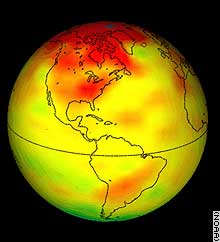
It's already here. Posted by Hello
It's not if, it's how bad: preparing for the climate crisis

Author Mark Hertsgaard begins his article in the San Francisco Chronicle Sunday Insight: "At the core of the global warming dilemma is a fact neither side of the debate likes to talk about: It is already too late to prevent global warming and the climate change it sets off. " Hertsgaard says that we have to shift from concentrating solely on preventing global heating to preparing for its effects.

His article puts in perspective the findings of the latest UN Panel on Climate Change, and more recent scientific realizations that the climate crisis has " already begun, and much sooner than expected. What's more, the problem is bound to get worse, perhaps a lot worse, before it gets better."

That's because this is the first systems crisis, challenging not only the ability of our political institutions to respond, but our maturity as a thinking species.

The climate crisis is a systems problem because the time lag between cause and effect. In systems theory this can cause a number of paradoxes, in combination with other factors. But the basic problem politically is that by the time the crisis is evident, it is too late to stop it. Or specifically, as Hertsgaard writes, there is a lag of from 50 to 100 years. Which means that the climate we have now is partly the result of what was poured into the air in the 1950s. Anything we do now to limit emissions may not appreciably change what will happen in the next 50 years or the rest of the 21st century.

This is also because that once global heating got started, it began essentially feeding on itself. This is where the concept of a tipping point is meaningful. Whenever it was, we have likely passed it.

The problem of understanding the dynamic was always central to the problem of focusing attention on the climate crisis. Apart from the greed and political advantage that kept this issue from assuming the priority it deserved, this lack of comprehension of time lag and complex systems behavior is why we didn't attack the climate crisis before it began.
(Ironically perhaps, and perhaps tragically, it is another time lag---between scientific and even quasi-scientific understanding of the basics of systems, and the general and political acceptance of that thinking---that may ultimately defeat us.)

So what do we do now? Hertsgaard says that concentrating exclusively on Kyoto and similar strategies is not enough, that we need to make plans to "defend ourselves" against the inevitable effects. But to do this in an effective and orderly manner requires what has been lacking: a general sense of crisis, and the political will to address it.

Why this is so and what can be done is a matter of increasing controversy among environmentalists and their organizations. One major contributor is the broadside authored by Michael Shellenberger and Ted Nordhaus, which among other assertions, takes the environmental movement to task for splitting its focus and competing to support pet projects while allowing the climate crisis to grow without public awareness.

Carl Pope of the Sierra Club issued a spirited rejoinder, agreeing with some of their points and disputing others, notably in a message to funders, found here:

Shellenberger and Nordhaus scorn suggestions that part of the problem is nomenclature, that "global warming" sounds too soft and cuddly, and therefore people don't get so concerned about it. I first raised this issue myself several years ago, along with making other suggestions to bring this issue to a public boil, here: And in a more recent essay in the SF Chronicle, here:

While I agree that much time has been lost because environmentalists haven't prioritized the issue, and worked together through a single organization, the problem of public awareness and political will is much more complicated. I still believe that nomenclature plays a part in public awareness, which is essential to putting pressure on politicians. "Global heating" and "climate crisis" are much more accurate as well as motivating terms than "global warming" and "climate change."

Similarly, the role of celebrities in focusing attention remains part of the mix, and in this, we may have caught a break. Right now the foremost U.S. celebrity who has made this his priority issue is Leonardo DiCaprio, with a TV documentary he narrates (in Canada, Alanis Morrisette and Keanu Reeves narrate similar documentaries.) With his Oscar nominated role in "The Aviator," Di Caprio's profile-and level of respect---is increasing.

The worst blow to climate crisis planning was the worst blow to addressing many other crucial problems---the continuing presidency of George W. Bush. So public awareness becomes even more important absent leadership from Washington.

But now the problem becomes not simply one of awareness, but of managing understanding. Sooner or later, the public is going to become aware that all the weirdness in the weather and other effects are linked to the cause of global heating. But choosing the right responses in a timely manner will be just as important as continuing to work to keep things from getting as bad as they could get in the future.

The most proximate danger, and the one we can do something about, is the Bush administration's wholesale robbery of the national budget well into the future. Those resources are going to be needed to fight the effects of the climate crisis, as well as working to prevent further deterioration.

No one yet mentions fighting the climate crisis as a reason to oppose what Bush is doing to pile up massive debt, but in the end it may turn out to be the most important reason.

We must end these excesses by defeating attempts to make tax cuts for the wealthy permanent, by defeating costly changes to Social Security, repealing very costly and counter-productive changes to Medicare, and ending the costly and counter-productive policy in Iraq.

That's the bare minimum. Sir David King, the UK's top scientific advisor, says that the climate crisis is "the biggest danger humanity has faced in 5,000 years of civilization."
It could end that civilization, as well as life on earth as we know it. For us, it is the supreme test of our "big brains" (as Kurt Vonnegut calls them) and their evolutionary value. Are we smart enough to foresee the crisis and the probable effects, and moral enough to set aside petty advantages including political ones, to do what must be done for the future.

Or will the world be plunged into chaotic crisis after crisis, from "natural" disasters to water wars, our hearts and minds armed with nothing but ignorance and fear?

Monday, February 14, 2005


California U.S. Senator Barbara Boxer with some of the 4,500 roses sent to her on Valentine's Day by supporters grateful for her stands opposing the seating of Ohio electors and confirmation of Condi Rice as Sec. of State. Posted by Hello
Give me an N! I mean a Q! What's that spell? Oh No!

While some reports on the Iraq election results emphasize that the Shiite clerical party didn't win big enough to rule, they fail to indicate what Robin Wright chooses to stress in her Washington Post report, that the Kurds---not the U.S. favored government slate---came in second, so that the election was dominated by Islamic religious candidates who are close to Iran.

She writes "When the Bush administration decided to invade Iraq two years ago, it envisioned a quick handover to handpicked allies in a secular government that would be the antithesis of Iran's theocracy -- potentially even a foil to Tehran's regional ambitions.

But, in one of the greatest ironies of the U.S. intervention, Iraqis instead went to the polls and elected a government with a strong religious base -- and very close ties to the Islamic republic next door. It is the last thing the administration expected from its costly Iraq policy -- $300 billion and counting, U.S. and regional analysts say. "

Iraq Winners Allied With Iran Are the Opposite of U.S. Vision (washingtonpost.com)

Friday, February 11, 2005


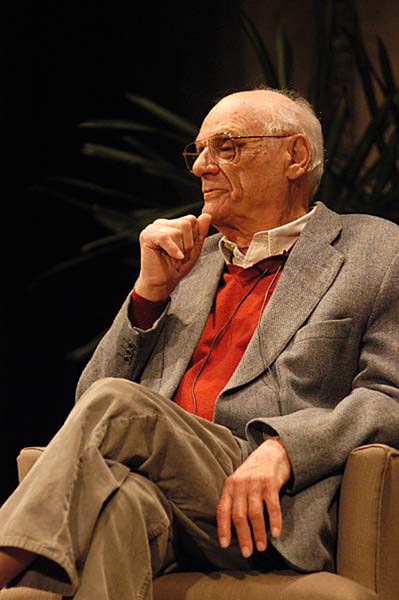
America's greatest living playwright, until today. Posted by Hello

Arthur Miller 1915-2005 Posted by Hello

"Death of a Salesman" Posted by Hello
A few days before my visit, the Tribune’s Sunday magazine had published a memoir by a woman who had been unable to get health insurance because she suffers from depression. Lipinski walked across her office to her desk and played back a voice-mail message she had received in response to the story. A woman’s voice said, “I’m really quite disgusted with the article on the uninsured. I think it’s very socialistic. Health care is not a right in this country. We are not Sweden and we are not Canada. I do not like these heart-tugging stories about people who don’t have health care. . . . Are you a socialist? . . . I do not appreciate these insipid little stories that say, ‘Oh, this poor person who doesn’t have health care.’ . . . I know friends and family who are really upset with the leftist tendencies of your coverage.” At this point, the voice-mail system timed out; it sounded as if the woman would gladly have kept going. “I get surprised,” Lipinski said. “Even something like this is seen through a political lens, rather than as, Here’s somebody with a different experience from me.”


The New Yorker: Fact