Thursday, September 08, 2005
“Perception is reality” is the mantra of imagery advisors like Frank Luntz, and the bread and butter of political operatives like Karl Rove. They’ve prospered by their fidelity to this guiding principle.
It is in a sense a corollary of their major guiding principle which can be expressed as “Politics is real, governing is illusion.”
But Katrina has created realities that cannot be managed. This is one of its sobering lessons for us all.
The Bush political machine worked its electoral magic by stage managing events, creating photo op imagery, and “re-framing” issues through the skillful manipulation of media.
They formulate a single perspective in a few words, and make sure it is endlessly repeated by their officials and party minions, so that it inevitably gets on the air and in print, and their faithful followers take it up on talk radio and in their blogs. They also feed the media with the novelty it needs, like the “new faces” and sensational assertions in the “Swift Boat” ads.
But having attained their goal through these and other means---that is, they got elected and re-elected---they have attempted to govern guided by these principles, to further their political goals and reward their friends. They have been pretty successful at this. They weathered storm after storm that easily could have brought them down. Until Katrina.
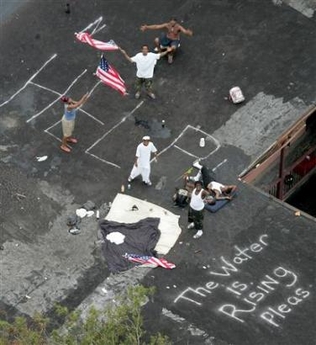
Katrina was real, and its effects are real, and will continue to be very real for a very long time. The lack of adequate federal response is real, and had real effects. Right now they are attempting to spin their way out of their responsibility. But attempting to manage perception is also at least partly why they failed.
Consider some of what we know about FEMA and its response to Katrina, and to earlier storms. The first FEMA director under Bush was Joe M. Allbaugh, a former Bush campaign manager. Before he left, he hired Mike Brown as his deputy. Brown had been his college roommate, had run his unsuccessful electoral campaign, and had just left---or been forced out of—his position with the International Arabian Horse Association, where he apparently organized horse shows.
Brown’s Chief of Staff, Patrick Rhode, planned events for the Bush White House, and did advance work for the Bush campaign. His deputy was a media strategist for the campaign, and before that the marketing director for a software company.
None of them had emergency management experience. Both of Brown’s key aides were essentially public relations specialists. Both of the directors had been political functionaries and Brown seems to have spent 11 years putting on shows with dumb animals, another qualification for political work.
Brown defended himself by pointing to other disasters he and his predecessor had successfully managed at FEMA. Yet their most conspicuous success seems to have been political.
An article in Perrspectives, which dubs FEMA the Federal Election Management Agency, reinterates the swift and massive response to four hurricanes in Florida just preceding the 2004 presidential election.
The article also cites hearings by the Senate Committee on Homeland Security and Government Affairs which revealed how generous Brown was with government relief funds, paying for home and car repairs in areas the hurricanes barely touched, and picking up the tab for over 300 funerals, more than twice the number of deaths attributed to the hurricanes.
In other words, some portion of $31 million in emergency relief payouts were political. They were up close and personal advertising, not with the goal of alleviating suffering but creating the perception that GW Bush was a good president, and Florida voters should show their gratitude at the polls.
Using relief fund for political purposes is hardly new, but add it to FEMA’s emphasis in Katrina, and managing perception appears to be not an adjunct but the major purpose of the Bush “relief efforts.”
Here are a few reported examples:
The Associated Press story quoting memos to the effect that Brown didn’t dispatch Homeland Security employees to the Katrina region until after the hurricane made landfall, and gave them two days to get there, had this final word: “Brown said that among duties of these employees was to "convey a positive image" about the government's response for victims.”
FEMA brought more than a thousand firefighters from around the country to Atlanta. They thought they were responding to the urgent plea of the Mayor of New Orleans for firefighters and search and rescue specialists. But they were instead kept there, and prepared to essentially be public relations representatives of FEMA. When 50 firefighters were finally dispatched to the Katrina zone, their mission was to stand around as props for President Bush’s appearances.
On Wednesday, Sept. 7, Reuters reports that FEMA is rejecting journalists’ requests to ride with rescue boats searching for storm victims, because it doesn’t want the media to photograph the dead.
None of this completely explains why FEMA was so late and so slow in its response, but it suggests that perception was an important consideration. This might help account for FEMA’s many documented refusals of help from Amtrak, the U.S. Navy, various corporations and individuals and so on, that would take them into the zone of destruction.
After all, it worked in Iraq. This administration has to some degree successfully managed perceptions of the Iraq war by limiting access to the war zone, forbidding the photographing of soldiers who died there, limiting access to prisoners at Guantanamo and fighting hard to prevent new photos and video from prisons in Iraq from becoming public.
But reporters were more easily able to get to the Katrina zone on their own, and some had family there. FEMA could not manage their perceptions, when they were staring at the reality.
Now America and the world have seen the stark reality of this disgraceful catastrophe. The spin is back in high gear, but the sobering reality continues to be seen and heard, and will be for some time to come.
This is a lesson for everyone who is engaged in politics, to understand that good governance is the goal, not political advantage. We must value a candidate’s qualifications and capabilities to govern as well as the candidate’s electability. That balance has eroded in recent years, but a catastrophe like Katrina may restore it in the minds of voters.
It is a lesson for those who habitually see reality chiefly through the lens of political perception, debating about message and re-framing and all the other tools of political perception management.
There is truly a sense in which perception creates reality, by being taken as an accurate reflection of reality. But we have also learned that managing perception does not always change reality. Sometimes reality has to be faced and dealt with, and managing the perception of it must be a secondary consideration, if it is considered at all.
Wednesday, September 07, 2005
Excerpted from Perspectives.
Mel Brooks once said, "it's good to be king." Well when it comes to hurricanes, it's even better being the President's brother. Especially in a vital swing state. In an election year.
Louisiana's Democratic Governor Kathleen Blanco is learning that the hard way. While her state suffered through a disastrous, disorganized and delayed response to Katrina from FEMA and the Bush administration, Florida governor Jeb Bush had no such problems as his state weathered four hurricanes in 2004.
There is no mystery to this discrepancy, as GovExec.com wrote in "How FEMA Delivered Florida for Bush" on November 3rd, 2004, literally the day after the President won reelection:
Now that President Bush has won Florida in his 2004 re-election bid, he may want to draft a letter of appreciation to Michael Brown, chief of the Federal Emergency Management Agency. Seldom has any federal agency had the opportunity to so directly and uniquely alter the course of a presidential election, and seldom has any agency delivered for a president as FEMA did in Florida this fall.
FEMA's preparation, performance and questionable largesse during the four 2004 Florida hurricanes stands in stark contrast with its abysmal failure in New Orleans in the wake of Katrina. While severe, the four Florida hurricanes (Charley, Frances, Ivan and Jeanne) caused under 100 deaths and $22 billion in damage, a fraction of Katrina's destructive force. Yet FEMA's proactive role and President Bush's timely and personal involvement in Florida bear no relation to 2005:
Hurricane Charley in August 2004 saw FEMA, National Guard troops, relief supplies and President Bush on stand by before the storm even made landfall. As the St. Petersburg Times reported on August 17th, 2004, "Governor Jeb Bush sought federal help Friday while Charley was still in the Gulf of Mexico. President Bush approved the aid about an hour after the hurricane made landfall."
Cargo planes flew FEMA supplies supplies from a Georgia Air Force base to a staging area in Lakeland, and the U.S. Army Corps of Engineers had stockpiled 11 truckloads of water and 14 truckloads of ice. Guy Daines, the former Pinellas County director of emergency services, was pleased and impressed with the rapid response of the National Guard and the delivery of pre-positioned supplies, stating "It amazed me how they got over 4,000 National Guard troops in there that quick. Rather than sit there and react, they are trying to get a jump-start on everything."
FEMA again prepositioned personnel, supplies, and equipment for the Frances, which struck in the first week of September. A FEMA press release offered a laundry list descriptio of preparations for Frances. 30,000 tarps, 100 truckloads of water and 100 truckloads of ice were already in place. Emergency medical teams and four urban search and rescue teams were already in place.
By September 6, 900,000 Meals Ready to Eat (MRE's) were stockpiled in Jacksonville. President Bush himself got into the act, distributing ice to Florida hurricane victims with brother Jeb.
This performance was repeated for Ivan and Jeanne, which hit two and three weeks later, respectively. Again, FEMA was in place with food, ice, water, and financial aid in advance of the arrival of the storms. By September 29, FEMA was providing detailed daily updates on its relief eforts, including over $360 million in aid to individuals. This assistance was augmented by the IRS, which granted tax relief for Florida hurricane victims.
Large and timely federal recovery funding was never an issue for the Florida Four. Congress passed $13 billion in recovery spending for the 2004 hurricanes, the bulk of which went to Florida. By August of 2005, $5.6 billion had been spent.
Whether that money had been spent wisely by FEMA director Michael Brown is another subject altogether. On May 18, 2005, the Senate Committee on Homeland Security and Government Affairs held hearings about waste and corruption in the Florida programs. In a session titled, "FEMA’s Response to the 2004 Florida Hurricanes: A Disaster for Taxpayers?,"
Senators Collins, Nelson and others grilled Michael Brown over his agency's largesse to residents of Florida. Florida Senator Nelson detailed numerous frauds perpetrated by Brown at FEMA. This featured over $31 million in payouts, including paying for home and car repairs, in Miami-Dade County, which had been virtually unaffected by the storms. More morose, FEMA managed to pay the costs of over 300 funerals statewide, even though medical examiners attributed only 123 to the hurricanes.
The rest, as they say, is history. Bush carried Florida over John Kerry by a surprisingly comfortable margin. As GovExec noted after election day, 2004:
"Bush later made a handful of other Florida visits to review storm-related damage, but the story on the ground was not Bush's hand-holding. Rather, it was FEMA's performance. It's impossible to know just how much of an effect FEMA had on the Florida vote...Even so, in a closely contested state where hundreds of thousands of voters suffered storm-related losses, it's equally hard to imagine that they didn't notice the agency's outreach."
As for Louisiana Governor Blanco, she shouldn't expect the Jeb treatment any time soon. In fact, portraying her and other state local officials as the bogeymen in the Katrina disaster is essential to the White House's strategy for Bush's political survival.
UPDATE (9/6): AP is reporting that FEMA Chief Mike Brown "waited until hours after Hurricane Katrina had already struck the Gulf Coast before asking his boss to dispatch 1,000 Homeland Security employees to the region — and gave them two days to arrive, according to internal documents." And yet, "Brownie" seems to enjoy job security.
Tuesday, September 06, 2005
Excerpts from A Failure of Leadership by BOB HERBERT in New York Times, subtitled "Bush to New Orleans: Drop Dead":
Neither the death of the chief justice nor the frantic efforts of panicked White House political advisers can conceal the magnitude of the president's failure of leadership last week. The catastrophe in New Orleans billowed up like the howling winds of hell and was carried live and in color on television screens across the U.S. and around the world.
Hospitals with deathly ill patients were left without power, with ventilators that didn't work, with floodwaters rising on the lower floors and with corpses rotting in the corridors and stairwells. People unable to breathe on their own, or with cancer or heart disease or kidney failure, slipped into comas and sank into their final sleep in front of helpless doctors and relatives. These were Americans in desperate trouble.
The president didn't seem to notice.
Death and the stink of decay were all over the city. Corpses were propped up in wheelchairs and on lawn furniture, or left to decompose on sunbaked sidewalks. Some floated by in water fouled by human feces.
Viewers could watch diabetics go into insulin shock on national television, and you could see babies with the pale, vacant look of hunger that we're more used to seeing in dispatches from the third world. You could see their mothers, dirty and hungry themselves, weeping.
Old, critically ill people were left to soil themselves and in some cases die like stray animals on the floor of an airport triage center. For days the president of the United States didn't seem to notice.
He would have noticed if the majority of these stricken folks had been white and prosperous. But they weren't. Most were black and poor, and thus, to the George W. Bush administration, still invisible.
After days of withering criticism from white and black Americans, from conservatives as well as liberals, from Republicans and Democrats, the president finally felt compelled to act, however feebly. (The chorus of criticism from nearly all quarters demanding that the president do something tells me that the nation as a whole is so much better than this administration.)
From Keith Olberman commentary on msNBC, transcribed at dkos:
But, nationally, these are leaders who won re-election last year largely by portraying their opponents as incapable of keeping the country safe. These are leaders who regularly pressure the news media in this country to report the reopening of a school or a power station in Iraq, and defy its citizens not to stand up and cheer. Yet they couldn't even keep one school or power station from being devastated by infrastructure collapse in New Orleans — even though the government had heard all the "chatter" from the scientists and city planners and hurricane centers and some group whose purposes the government couldn't quite discern... a group called The U.S. Army Corps of Engineers.
And most chillingly of all, this is the Law and Order and Terror government. It promised protection — or at least amelioration — against all threats: conventional, radiological, or biological.
It has just proved that it cannot save its citizens from a biological weapon called standing water.
Mr. Bush has now twice insisted that, "we are not satisfied," with the response to the manifold tragedies along the Gulf Coast. I wonder which "we" he thinks he's speaking for on this point. Perhaps it's the administration, although we still don't know where some of them are. Anybody seen the Vice President lately? The man whose message this time last year was, 'I'll Protect You, The Other Guy Will Let You Die'?
For many of this country's citizens, the mantra has been — as we were taught in Social Studies it should always be — whether or not I voted for this President — he is still my President. I suspect anybody who had to give him that benefit of the doubt stopped doing so last week. I suspect a lot of his supporters, looking ahead to '08, are wondering how they can distance themselves from the two words which will define his government — our government — "New Orleans."
As we emphasized to you here all last week, the realities of the region are such that New Orleans is going to be largely uninhabitable for a lot longer than anybody is yet willing to recognize. Lord knows when the last body will be found, or the last artifact of the levee break, dug up. Could be next March. Could be 2100. By then, in the muck and toxic mire of New Orleans, they may even find our government's credibility.
Monday, September 05, 2005
What do you think of the "Gush-Bore" 2000 election now? Still see no difference?
From Newsweek:
President Bush could have "federalized" the National Guard in an instant. That's what his father, President George H.W. Bush, did after the Los Angeles riots in 1992. Back then, the Justice Department sent Robert Mueller, a jut-jawed ex-Marine (who is now FBI director), to take charge, showing, in effect, that the cavalry had arrived. FEMA's current head, Michael Brown, has appeared over his head and even a little clueless in news interviews.
Up to now, the Bush administration has not hesitated to sweep aside the opinions of lawyers on such matters as prisoners' rights. But after Katrina, a strange paralysis set in. For days, Bush's top advisers argued over legal niceties about who was in charge, according to three White House officials who declined to be identified because of the sensitivity of the negotiations.
While Washington debated, the situation in New Orleans and along the Gulf Coast deteriorated.
While this is from the Marysville, Tenn. Daily Times:
An American Airlines plane arrived at McGhee Tyson Airport at 3:10 p.m. Saturday with about 130 people from New Orleans.
Former Vice President Al Gore was on the plane, helping patients. He did not grant interviews to reporters Saturday.
`My understanding was that he made this happen, that he actually arranged for this aircraft,'' Webb said.
Ninety of the passengers were patients from Mercy Hospital in New Orleans, according to Knox County spokesman Dwight Van de Vate.
A dozen patients were taken to Blount Memorial Hospital. Ten were treated and released. Two were admitted to the hospital. Those not admitted to Blount Memorial Hospital will go to a shelter at Blount Christian Church in Maryville. Three people checked into the shelter on Saturday.
Several patients were diabetic, and some needed dialysis. Many patients had been without medication for ``several days,'' but were ``relatively stable,'' said Dr. Roger Brooksbank, an emergency physician with Team Health at Blount Memorial Hospital.
The remaining 40 passengers were evacuees who needed no ``acute medical care,'' according to Van de Vate. Regardless, all were taken to hospitals in Knoxville, Blount County, Oak Ridge and Jefferson County for evaluation.
Sunday, September 04, 2005
By ALLEN G. BREED, Associated Press Writer
NEW ORLEANS - Thousands more bedraggled refugees were bused and airlifted to salvation Saturday, leaving the heart of New Orleans to the dead and dying, the elderly and frail stranded too many days without food, water or medical care.
No one knows how many were killed by Hurricane Katrina's floods and how many more succumbed waiting to be rescued. But the bodies are everywhere: hidden in attics, floating among the ruined city, crumpled on wheelchairs, abandoned on highways.
And the dying goes on — at the convention center and an airport triage center, where bodies were kept in a refrigerated truck.
By TODD S. PURDUM The New York Times
"It really makes us look very much like Bangladesh or Baghdad," said David Herbert Donald, the retired Harvard historian of the Civil War and a native Mississippian, who said that Gen. William Tecumseh Sherman's destructive march from Atlanta to the sea paled by comparison. "I'm 84 years old. I've been around a long time, but I've never seen anything like this."
By MATT CRENSON, AP National Writer
Katrina may seem like the last word in hurricanes, but there is a very real possibility that another major hurricane may hit New Orleans or some other portion of the 200-mile coastline devastated by Katrina in the weeks to come.
"We're not out of the woods yet," said Susan Cutter, director of the University of South Carolina Hazards Research Laboratory. "We're not even in the height of hurricane season."
A forecast released Friday by meteorologists at Colorado State University calls for six more hurricanes by the time the hurricane season ends on Nov. 30, three of them Category 3 or above. On average, about one major hurricane in three makes landfall in the United States.
"We expect that by the time the 2005 hurricane season is over, we will witness tropical cyclone activity at near record levels," the Colorado State meteorologists wrote.
Saturday, September 03, 2005
by Jordan Flaherty, editor of leftturn.org, begins:
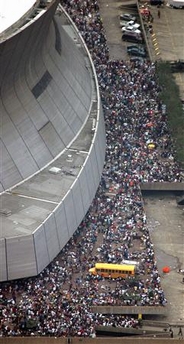
"I just left New Orleans a couple hours ago. [Friday] I traveled from the apartment I was staying in by boat to a helicopter to a refugee camp. If anyone wants to examine the attitude of federal and state officials towards the victims of hurricane Katrina, I advise you to visit one of the refugee camps. In the refugee camp I just left, on the I-10 freeway near Causeway, thousands of people(at least 90% black and poor) stood and squatted in mud and trash behind metal barricades, under an unforgiving sun, with heavily armed soldiers standing guard over them. When a bus would come through, it would stop at a random spot, state police would open a gap in one of the barricades, and people would rush for the bus, with no information given about where the bus was going. Once inside (we were told) evacuees would be told where the bus was taking them -Baton Rouge, Houston, Arkansas, Dallas, or other locations. I was told that if you boarded a bus bound for Arkansas (for example), even people with family anda place to stay in Baton Rouge would not be allowed to get out of the bus as it passed through Baton Rouge. You had no choice but to go to the shelter in Arkansas. If you had people willing to come to New Orleans to pick you up, they could not come within 17 miles of the camp.
I traveled throughout the camp and spoke to Red Cross workers, Salvation Army workers, National Guard, and state police, and although they were friendly, noone could give me any details on when buses would arrive, how many, where they would go to, or any other information. I spoke to the several teams of journalists nearby, and asked if any of them had been able to get anyinformation from any federal or state officials on any of these questions, and all of them, from Australian tv to local Fox affiliates complained of an unorganized, non-communicative, mess. One cameraman told me as someone who’s been here in this camp for two days, the only information I can give you is this: get out by nightfall."
For more reporting plus the best description of what New Orleans was like in its prime (last week), go to this post on Booman Tribune.
For more stories, go to Dreaming Up Daily.
Friday, September 02, 2005
By Alan Elsner Fri Sep 2,11:54 AM ET
WASHINGTON (Reuters) - Virtually everything that has happened in New Orleans since Hurricane Katrina struck was predicted by experts and in computer models, so emergency management specialists wonder why authorities were so unprepared.
In comments on Thursday, President George W. Bush said, "I don't think anybody anticipated the breach of the levees."
But Louisiana State University engineer Joseph Suhayda and others have warned for years that defenses could fail. In 2002, the New Orleans Times Picayune published a five-part series on "The Big One" examining what might happen if they did.
It predicted that 200,000 people or more would be unwilling or unable to heed evacuation orders and thousands would die, that people would be housed in the Superdome, that aid workers would find it difficult to gain access to the city as roads became impassable, as well as many other of the consequences that actually unfolded after Katrina hit this week.
For a sequence of other stories, check Dreaming Up Daily.
Thursday, September 01, 2005
What is the difference between New Orleans and Baghdad? Both are without electricity, though Baghdad has it some of the time, both have sewage and dead bodies in the streets, people shooting from buildings, and Halliburton looking to make a fortune. Both are populated by angry people tired of Bushcorp's empty promises.
While the situation is worse in New Orleans--no food or water or shelter to speak of--- Baghdad has been suffering longer. So what are the big differences?
So far, two come to mind. First, Iraq has alot of the US National Guard, and doesn't want them. While New Orleans desperately needs them, and doesn't have them.Second, many other nations in the world refused to ally themselves with the US invasion and occupation of Iraq. But many nations, including Canada and Russia, have offered real, meaningful and much needed help--trained personnel, equipment, resources---that are ready to hit the ground running, and the US so far is refusing it.
What are they waiting for---Halliburton? They done such wonders in Baghdad, after all.
By Mark Babineck
NEW ORLEANS (Reuters) - Rotting bodies littered New Orleans' streets on Thursday and troops headed in to control looting and violence, as thousands of desperate survivors of Hurricane Katrina pleaded to be evacuated from the flooded city, or even just fed.
No plan ever made to help New Orleans' most vulnerable
By LEONARD WITT Atlanta Constitution Published on: 09/01/05
"Each time you hear a federal, state or city official explain what he or she is doing to help New Orleans, consider the opening paragraphs of a July 24 story in the New Orleans Times-Picayune.
"City, state and federal emergency officials are preparing to give the poorest of New Orleans' poor a historically blunt message: In the event of a major hurricane, you're on your own.""
The falcon cannot hear the falconer;
Things fall apart; the centre cannot hold;
Mere anarchy is loosed upon the world,
The blood-dimmed tide is loosed, and everywhere
The ceremony of innocence is drowned;
The best lack all conviction, while the worst
Are full of passionate intensity."
William Butler Yeats
Tuesday, August 30, 2005
New Orleans and other Louisiana and Mississippi cities and towns now face mammoth cleanup and repair work from hurricane Katrina. Health and safety are threatened, and the entire nation’s economy may hang in the balance.
It’s the time for the National Guard. But they aren’t there. Neither is their equipment.
Over 3,000 members of the Louisiana National Guard 256th brigade is in Iraq. So is their equipment—including high water vehicles and generators, particularly important in flood disasters.
Of the many deformities to this nation perpetrated by Bushwar Inc., the misuse of the National Guard is one of the scariest. Not only are men taken from their jobs and families who depend on them; not only are they usually no longer young and not really trained for what they face in Iraq, and so they die and are wounded for no good reason and a lot of bad ones, but the nation they are supposed to guard is left defenseless in emergencies like this one.
It’s unlikely this is the last hurricane to do damage this year. More frequent and more ferocious storms have been predicted by climate crisis models for years, and the trend is starting to show. At a time we ought to be anticipating danger to lives, infrastructure and the economy, we’re bleeding ourselves dry in Iraq. The United States of denial cannot stand.
UPDATE: Though other National Guard units were said to be deployed to the disaster area, they were apparently not present in force in New Orleans by Wednesday the 31st. According to figures broadcast by Democracy Now!, 40% of the Mississippi National Guard personnel and 35% of the Louisiana Guard are in Iraq. Louisiana's Guard has suffered 23 deaths in Iraq, more than any other state except New York, which also lost 23.
Friday, August 26, 2005
Free Speech? You Can't Even Buy It
Television networks have been living off the twin notions that paid advertising is free speech, and that in order to speak freely, you have to pay. All those millions corrupting the US political process, all those officeseekers and office holders who are wholly owned by big money interests and their "lobbyists" who not only dictate laws but write them, they all wind up in the pockets of the media, mostly television.
Is it free speech if everyone doesn't have equal access? Apparently not.
What's even worse however, is that not everyone has equal access even if they show them the money.For years, TV networks in Canada and the US refused to air anti-consumption and pro-environment ads sponsored by adbusters magazine. Nobody noticed.
But two new instances are attracting a bit more attention.One is the Gold Star Mothers For Peace who tried to buy time for a powerful 15 second statement by Cindy Sheehan. Several TV stations refused, one of them, a CBS affiliate in Boise, because the ad was not "factually accurate" questioning the assertion that President Bush lied to the American people. This sets a standard of truth that few of its commercials could meet, not to mention the Swift Boat ads lying about John Kerry.
But even with that standard, the burden of proof for Bush's lies isn't hard to meet.The ad is being shown on CNN, and is available for viewing at various sites on the Internet, including truthout.
Another troubling case is the networks refusing to air ads critical of the networks' lack of coverage of the Sudan and other African human crises. The Sheehan ad instance is craven, pandering to the rich and powerful who will buy more ads than the Gold Star Mothers for Peace ever will. But this instance is sheer cowardice. If the fact of the networks almost totally ignoring genocide and starvation in favor of celebrity gossip isn't evidence enough, their censoring of ads because they tell the truth about their failure completes the picture of their corruption.
Wednesday, August 24, 2005
This is the nightmare we knew we were in for when the first ‘shock and awe’ bombs fell, and no one knows how or when it’s going to end, except that it won’t be any time soon.
Do you remember those “Saturday Night Live” sketches during the weeks after the 2000 election when the result was still in doubt? One of them showed GW in the White House, looking shell shocked, hiding under his desk as part of his office was on fire, because he’d screwed up so badly.
It may be a little like that in the White House now (or it would be, if he were there.) The American Research Group survey shows his approval rating is at 36%, a point lower than Nixon’s after the Watergate hearings and impeachment hearings, and just before he resigned. Iraq is a major contributing cause to those numbers, though the economy isn't far behind.
Bush left his increasingly besieged ranch to address the organization most likely to support him on Iraq, the VFW, in the reddest of the red states, Utah. Though there were dissenters, the VFW gave him the predictable warm welcome, but there were 2,000 protestors nearby, led by the Mayor of Salt Lake City. (Story with photos here.)
Bush and the Bushites have fallen back on the most craven McCarthyism (a White House spokesperson suggesting that war opponents don’t want the US to win the war on terror; Rumsfeld making grand analogies to people who didn’t support World War II) while turning his blind eye of denial on the draft Iraqi constitution, which has others wondering if all this blood and treasure was devoted to creating an impoverished Islamic state on the brink of civil war.
Bush’s central arguments haven’t changed since the campaign, except that some of the reasons he says he started the war has obviously changed. They were reiterated yesterday, as they were last month, when a young Iraqi woman in Iraq who calls herself riverrun, commented on them in her blog, “Baghdad Burning.” She responded to the connection Bush is making with even greater frequency now, that the war in Iraq is the war on terror:
"Do people really still believe this? In spite of that fact that no WMD were found in Iraq, in spite of the fact that prior to the war, no American was ever killed in Iraq and now almost 2000 are dead on Iraqi soil? It’s difficult to comprehend that rational people, after all of this, still actually accept the claims of a link between 9/11 and Iraq. Or that they could actually believe Iraq is less of a threat today than it was in 2003.
We did not have Al-Qaeda in Iraq prior to the war. We didn’t know that sort of extremism. We didn’t have beheadings or the abduction of foreigners or religious intolerance. We actually pitied America and Americans when the Twin Towers went down and when news began leaking out about it being Muslim fundamentalists- possibly Arabs- we were outraged.Now 9/11 is getting old. Now, 100,000+ Iraqi lives and 1700+ American lives later, it’s becoming difficult to summon up the same sort of sympathy as before. How does the death of 3,000 Americans and the fall of two towers somehow justify the horrors in Iraq when not one of the people involved with the attack was Iraqi?"
She quotes Bush's speech--“We continued our efforts to help them rebuild their country. Rebuilding a country after three decades of tyranny is hard and rebuilding while a country is at war is even harder."--and responds:
Three decades of tyranny isn’t what bombed and burned buildings to the ground. It isn’t three decades of tyranny that destroyed the infrastructure with such things as “Shock and Awe” and various other tactics. Though he fails to mention it, prior to the war, we didn’t have sewage overflowing in the streets like we do now, and water cut off for days and days at a time. We certainly had more than the 8 hours of electricity daily. In several areas they aren’t even getting that much."
To Bush's statement--“They are doing that by building the institutions of a free society, a society based on freedom of speech, freedom of assembly, freedom of religion and equal justice under law.”--she indicates that the Iraqi forces being trained are already becoming known as ruthless tools of the US.
"We’re so free, we often find ourselves prisoners of our homes, with roads cut off indefinitely and complete areas made inaccessible. We are so free to assemble that people now fear having gatherings because a large number of friends or family members may attract too much attention and provoke a raid by American or Iraqi forces.
As to Iraqi forces…There was too much to quote on the new Iraqi forces. He failed to mention that many of their members were formerly part of militias, and that many of them contributed to the looting and burning that swept over Iraq after the war and continued for weeks."
“The new Iraqi security forces are proving their courage every day.” (She quotes Bush, and replies: "Indeed they are. The forte of the new Iraqi National Guard? Raids and mass detentions. They have been learning well from the coalition. They sweep into areas, kick down doors, steal money, valuables, harass the females in the household and detain the men. The Iraqi security forces are so effective that a few weeks ago, they managed to kill a high-ranking police major in Falluja when he ran a red light, shooting him in the head as his car drove away."
These are hard truths, that most Americans aren't getting---although it seems they know this. Another survey shows that 60% of Americans don’t feel they get enough information on military matters to make decisions as voters, and their confidence in the media to provide this information is slipping. They apparently don’t expect it from the military itself---three fourths expect the military to lie.
Add to this the continuing carnage in Iraq, the stories that suggest the US is digging in (or more accurately, creating a citadel city within Baghdad) to stay for a long while, and the increasingly ugly Bushwhacker attacks on anyone--including fellow Republicans--who criticize this Iraqmire.
But perhaps the greatest tragedy (which many, including GW's own father, foretold) is that there is now no good solution. Getting out of Iraq is essential, but no one seems to know how to do it in a way that prevents or even mitigates likely disaster in the region for a long time.
Asked about Bush's call for teaching "intelligent design" in school science, John Kerry replied that Bush would be better off with some intelligent design for Iraq. Unfortunately there doesn't seem to be any.
Monday, August 22, 2005
High gas prices are already affecting the US economy, and several other events may be about to combine to create what some are calling the Perfect Storm that could sink this economy and who knows what else before it’s through.
A storm of its own was created on several of the bluish community blogs with a post and lots and lots of comments revealing that a change in law about to go into effect in October may well mean that credit card minimum payments will be instantly doubled.
It’s a change in how the minimum is figured, and you can get the whole ugly story, including many speculations on what it means as well as descriptions of how the credit card situation got so sordid and personal stories of its likely impact here at dkos, but it’s also posted at the Booman Tribune and the European Tribune (the difference in comments is interesting in itself, if you’re not too shell-shocked to notice.)
This is pretty unknown, even among experts and certainly among consumers. Banks are bracing for defaults, but some speculate that the impact in defaults, bankruptcies and curtailed consumer spending and small business investment and other month-to-month activity (often done on credit cards) will be enormous.
Speaking of bankruptcy, a front page story in the New York Times Sunday was front page news all over the country: there’s a rush on declaring bankruptcy before the law changes (also in October, oddly enough), making it essentially impossible for many people to get out of debt.
That’s October---you know, when there’s already Christmas music at the malls.
The prospects for a very bad retail season is only the beginning, the first gales of this perfect storm. The impact of the credit card increases and bankruptcy law changes will continue to gather momentum, and winter heating oil gets into the mix of oil prices. There were stories this weekend about the uncertainty and perhaps exaggeration of Saudi oil reserves, and the oncoming if not imminent decline of oil coming out of the ground.
There were also stories about the likely end of the housing bubble within the next few years, if not sooner. Meanwhile, there are possible stormclouds from the east as a weakening consumer economy and higher interest rates coupled with huge federal deficits and the continuing drain of billions into the Iraq debacle start to worry the banks of China and others who hold so much US government debt, and are therefore the key players in the American dollar.
Economic storms get started partly based on perception, and one bit of bad news sours the mood towards others. An administration in steadfast denial might look increasingly untrustworthy, especially with a prominent Republican Senator (Chuck Hagel) calling the Iraq war another Vietnam and demanding US withdrawal, while several conservative pundits are voicing great displeasure that American blood and treasure may be paying for an Islamic state in Iraq, which is a distinct possibility according to news about the Iraqi constitution now being drafted.
So what happens when credit cards aren’t an option, stocks and bonds are falling, real estate trembles and even dollars and T-bills don’t look secure? That’s part of the perfect storm. It might have been avoided with less greedy banks and less accommodating legislators who refused to pass even a 30% cap on credit card interest, and of course an administration that didn’t start a costly and obscenely unnecessary war, give the treasury away to its crony corporations, and pay the rich with the earnings of generations of working Americans (which is what they do when the Social Security fund is routinely raided to pay for deficits.)
Do we even have to add health care costs, which drain the national economy and are a chief reason for so much credit card debt and bankruptcy, and the climate crisis, which is already costing consumers and governments and will only demand more resources summer by summer, year by year.
The people who will get hurt the most are probably the least responsible for this storm, especially if they didn’t vote for Bush. But it doesn’t matter. We may all reap the whirlwind.
Saturday, August 20, 2005
Some guys have all the luck. Or they make their own luck, by hiring the right sort of thieves, knaves and evildoers.
The opinion stated here in this space that voting rights needs to be one of the top campaign issues in the next election cycles got some ammunition from Paul Krugman's new column in the New York Times on how the election of 2000 was definitely stolen, the election of 2004 may have been, and if people don't wake up, you can kiss 06 and 08 goodbye as well.
Krugman writes:
In his recent book "Steal This Vote" - a very judicious work, despite its title - Andrew Gumbel, a U.S. correspondent for the British newspaper The Independent, provides the best overview I've seen of the 2000 Florida vote. And he documents the simple truth: "Al Gore won the 2000 presidential election."
Two different news media consortiums reviewed Florida's ballots; both found that a full manual recount would have given the election to Mr. Gore…But few Americans have heard these facts. Perhaps journalists have felt that it would be divisive to cast doubt on the Bush administration's legitimacy…Meanwhile, the whitewash of what happened in Florida in 2000 showed that election-tampering carries no penalty, and political operatives have acted accordingly. For example, in 2002 the Republican Party in New Hampshire hired a company to jam Democratic and union phone banks on Election Day.”
Katharine Harris, who parlayed her service to the Bushcorps into a seat in Congress, is well known for her partisan decisions as Secretary of State in Florida, as well as overseeing the disqualification of thousands of legal voters through the misuse of a computerized felon list, unchecked and full of errors.
Although Gumbel’s book doesn’t question the 2004 outcome, Krugman cites two reports on it, one by the DNC and the other by Congressman John Conyers. Both describe the hours long lines in predominately Democratic districts, caused by too few voting machines, and people forced to cast provisional ballots which were never counted.
Conyers also cites case after case of partisanship by the Republican Secretary of State in Ohio who also ran the Bush campaign there (remember that Ohio was the only state that Bush visited on election day?) – “makes Ms. Harris's actions in 2000 seem mild by comparison.”
Krugman concludes:
And then there are the election night stories. Warren County locked down its administration building and barred public observers from the vote-counting, citing an F.B.I. warning of a terrorist threat. But the F.B.I. later denied issuing any such warning. Miami County reported that voter turnout was an improbable 98.55 percent of registered voters. And so on.
We aren't going to rerun the last three elections. But what about the future?
Our current political leaders would suffer greatly if either house of Congress changed hands in 2006, or if the presidency changed hands in 2008. The lids would come off all the simmering scandals, from the selling of the Iraq war to profiteering by politically connected companies. The Republicans will be strongly tempted to make sure that they win those elections by any means necessary. And everything we've seen suggests that they will give in to that temptation. "
Meanwhile, the Daily Pick reveals that President Bush's latest accomplishment is breaking the all-time record for most vacation days by a president of the United States. Ronald Reagan held the old record of 335 days, though Reagan did it over eight years. President Bush surpassed it in nearly half the time!
And despite the presence of Cindy Sheehan and a growing number of Gold Star Mothers and other protestors, not to mention world press, a few miles away, Bush has two more weeks on his current vacation---and three years and change to set a standard in brush-clearing obliviousness that will challenge the next generation of figureheads for election thieves.
Wednesday, August 17, 2005
Cindy Sheehan began as a news item, was speedily inflamed into a controversy, and is fast become a phenomenon, maybe even a legend.
Before all of that, she was a mother---the mother of a soldier killed in Iraq. That seems to be the center of her power over the American imagination at the moment.
The American penchant for the cult of personality can be disquieting, contending forces inflating virtues and flaws with equal vehemence. But even with that caution, that sense of unease, this phenomenon is amazing.
This is not a celebrity. This is not another pretty face. But this achingly real person is becoming the central symbol in a still expanding national drama.
She is the center of a storm of strong feelings on both sides, and despite contending pundits and bloggers, the real difference right now is that the usually anonymous American public is becoming part of this.
Just the past 24 hours illustrate this: a presumably angry opponent of her protest used a pickup truck to destroy a number symbolic grave markers---wooden crosses with the names of Americans killed in Iraq---that was part of the Camp Casey protest site outside Crawford, Texas. And shortly after that, a farmer who owns a larger piece of land nearby offered its use to Cindy Sheehan so Camp Casey could be relocated. He is a veteran and had supported her silently, until the crosses were run down.
Meanwhile the number of protestors in Crawford grows every hour, and George Bush is stuck a few miles away at his ranch, because to leave before the scheduled end of his vacation several weeks from now would be to admit defeat.
Among the expected arrivals is another Gold Star mother, whose son was killed in Iraq. More may follow.
Demonstrations in support of Cindy Sheehan have occurred already in New York, San Francisco and elsewhere. Move On is sponsoring candlelight vigils in cities and towns all over the country for tonight (Wednesday). Information can be found here.
This is an unprecedented event, awesome if for only that reason. Nothing like this happened all the years of Vietnam. Whether the Rabid Right sensed this might happen, or their quick barrage of vicious character assassination helped create this phenomenon, the fact is that one American mother has become the symbol for the revolt of the usually voiceless, united with others heartfelt in their opposition to this war.
But as much as the Bushhead apologists would like to shift the focus onto favorite targets, what they must fear about this is the participation and leadership of families who have so far silently given up their young to a war begun by the arrogant and powerful, who sacrifice nothing and expected to reap the spoils.
Americans as a rule know little about Europe, possibly even less than Europeans knew about America a half century ago, when Europeans seemed to think Al Capone was still running Chicago and cowboys roamed the West. Well...maybe they were onto something.
Today’s American ignorance is less innocent. Along with the smug complacency and disbelief that we Americans could possibly learn anything from foreign lands, our ignorance of today’s Europe consists of holdover imagery carefully nurtured by big business Repubs, neocons who don’t want their delusions of empire spoiled by the hard-earned insights of Europe, and rabid rightists who certainly don’t want Americans to see European economic successes, particularly the vibrant manufacturing coupled with strong labor unions, universal health care and other social support---and workers with greater job security, shorter work week and more vacations!
A few years ago in The Unconquerable World, Jonathan Schell movingly described how the European Union was forging a system for permanent peace in the region that had put itself through hell for several hundred years, and the rest of the world twice in the twentieth century.
Then last year, in The European Dream, Jeremy Rifkin developed a case for Europe’s vision of the future replacing the American dream that has dominated globalism so far.
I just caught up to Thomas Geoghegan’s July 11 piece in the Nation magazine, just after the “no” votes on the EU Constitution in France and Holland surprised U.S. media into paying Europe some attention. Geoghegan begins by saying that the alarmist talk at the time was excessive, and that in most of Europe “things are pretty nice”---in ways that would make a lot of American envious.
He notes that a 2004 Goldman Sachs study shows that a big chunk of Europe has been doing at least as well economically as the U.S., and when you take a closer look behind the numbers, the picture gets even better.
The higher unemployment rate in France, for example, masks the fact that employed French workers are much more secure, and that over time, a higher proportion of American workers are out of work for significant periods than French workers. European standard of living is going up as fast as America’s by the numbers, but if you put a cash value on the extra leisure Europeans have due to shorter work weeks and more vacations, it’s likely it’s going up faster.
Why do American big business elites deride Europe? Possibly because the top execs don’t make as much there, and in France the income gap between top and bottom is decreasing, not increasing at an obscene rate as it is here.
Figuring in the anomalies of American employment figures, “It’s plausible that in the past ten years most of Europe has done better than the United States---even as Europeans keep working fewer hours.” Though he doesn’t mention it, Europeans also don’t have to spend exorbitant amounts on health care or pensions that their companies conveniently disappear when they get in trouble, while golden parachutes remain open; they don’t worry they might die without medical care, or that the retirement they thought was secure suddenly vanishes.
Geoghegan dismisses the euphoria over China’s economic gains---just catch-up, he maintains, as were Japan’s in the 70s. He derides Friedman’s ‘flat world” theory (i.e. globalized on the American model, with Chinese takeout) and drops this little tidbit that puts the lie to its rightist apologists:
“Last year, according to the WTO, German export goods had a value of more than $915 billion. China’s had a value of about $593 billion. In a so-called flat world, it turns out that the country with the world’s highest labor costs is the world’s champion exporter. Add in France, eta al, and the EU is even further ahead…"
A key to this is that while corporations in the US found it necessary to dismantle the nation’s industrial infrastructure and destroy the middle class to enrich the rich and slowly impoverish the rest (Let them eat Wal-Mart!), Europe held on to its factories and its industrial jobs, which have far more protections for workers than even unionized U.S. plants once did.
In the creation of economics and governments that engender prosperity while providing good jobs, security, health care and a better quality of life; in creating a more perfect union that, despite its ups and downs, is a nearly miraculous model of peace among nations, and even in how it is confronting the difficulties of multicultural societies that the US will also have to face in the 21st century, Europe is worth our close attention over here.
Over there, however, the danger (according to Geoghegan) is partly fostered by over here. “The threat to Europe right now,” he concludes, “is the violence of the rhetoric against the model [of Europe in the last decade], the bizarre gloom and doom when it is actually doing well. The nerve-wracking thing about Europe at the moment is the possibility that ordinary Europeans will lose their nerve and just cave in to their American-wannabe elites.”
Tuesday, August 16, 2005
They’ve gotten away with this for far too long, living off the fantasies of their snake oil slogans, as well as their lies. Now is the time to call them on it all. If privatization of everything—-from prisons and schools to energy and water, and from health care to Social Security---is so great, let’s see you prove it.
There are enough examples out there now, some running for decades. Show us the money you saved. Show us the efficiency of the private sector, the magic of the marketplace in providing better and more affordable health care, cheaper energy, better schools at lower costs. Spare us the platitudes. Prove it. Prove that privatization works.
The time is right to make this demand because privatization has suffered what looks so far like it’s first major defeat. As Paul Krugman says in his column, Bush’ plan to “reform” Social Security was seen for what it was, as privatization of public insurance, turning it into a risky investment benefiting bankers rather than a guaranteed social safety net earned by every American worker for their old age.
Krugman draws some general lessons. For example: “But the campaign for privatization provided an object lesson in how the administration sells its policies: by misrepresenting its goals, lying about the facts and abusing its control of government agencies. These were the same tactics used to sell both tax cuts and the Iraq war. “
The lies continue, he warns, as Bush officials lie shamelessly about the vulnerabilities and design of Social Security. But the “public's visceral rejection of privatization” should embolden Democrats to go after the Bushers for their “pattern of deception” on this and other major matters, Krugman says.
But there’s another opportunity here, which is to bring the debate on the whole mythology of privatization into a sharp focus, and finally demand that if proponents believe that privatization works so well, it’s time to prove it.
The policy of privatization emerged as one of the major mantras and most destructive changes that began in the 1980s and still threatens America’s future today. Privatization is another way that America turned itself inside-out, reversing what had been public with what had been private.
Privatization became policy in the Reagan years, when the relationship between big money (individuals and corporations) and politicians (mostly Repub and ultra-conservative, but not exclusively) stopped being kissing cousins and started on the road to blatant incest.
While big money worked its wonders behind the scenes, buying politicians, media outlets and making media stars (either merely subservient or wholly owned), the campaign succeeded politically through a new rhetoric: disguised as good old boy common sense, it was insidiously effective advertising sloganeering, so slippery and yet so outrageous that it left opponents speechless.
Privatization followed the so-called taxpayer revolt of the 1970s, which cut municipal and state taxes so severely that public schools, public health and public infrastructure gradually but decisively deteriorated. It also followed Reagan’s federal tax cuts and budget cuts, which further reduced public funding to these state and local programs.
Then came the heavy guns of rhetoric. How were all these public services going to be financed with less tax money, opponents wanted to know. Easy—privatize them! They were just wasting the taxpayer’s hard earned money anyway, full of fraud and abuse. That kind of thing would never go on in a private company! Private companies have to be efficient, they have to deliver. Let them compete and free the magic of the marketplace. Replace the pencil-pushers with hard-nosed can-do entrepreneurs, the kind that made America great.
After the junk bond scandals of the 80s, and certainly after Enron, which privatized energy and rippedoff California’s taxpayers for billions to pay for electricity at prices that had no basis in any reality except the deception and greed of corporate criminals and their political supporters, that such arguments would be laughed off the stage. But they are still being made, every day.
The latest arena is water. Municipalities all over North America (as well as in the UK and virtually everywhere globalization reaches) are under pressure to sell their water systems to corporations. Who, they claim, can deliver water more efficiently at a better price to consumers, while relieving taxpayers of the burden.
Water is just about the last major public utility to survive in America. Despite all the bottles of water everyone carries, and all the pollution and chemical poisons that efficient private industries have poured into the rivers and lakes, and leached into the water table (for getting others to pay for your waste is part of being efficient), America’s municipal water systems are still quite good. They deliver reasonably high quality and healthy water to every home reliably and at low cost.
Not in Atlanta, however, when it turned to a private company to supply its water. The company withdrew from the market after several years of disaster, including violation of federal drinking water health standards. Ten regional water systems in the UK were privatized, resulting in 50% price hikes, and soaring disconnection rates, thanks to efficient meters that automatically shut off the water when a customer failed to “pre-pay.”
Most other privatizations have been equally disastrous or worse. Even the war in Iraq has been privatized, with privately contracted torture management and Halliburton’s efficient use of food service funds to provide soldiers with spoiled food while creating sumptuous feasts for company executives and their cronies.
The time is also ripe to use the “prove it” demand to change the health care debate. The US privatized health care system is in effect nothing less than barbarous. The burden of proof should not be for proponents of public funding for universal health care, but for the supporters of the current system to prove that it shouldn’t be dismantled immediately, and the officers of HMOs forced to get all their medical care in emergency rooms.
Sunday, August 14, 2005
The “tipping point” terminology has been used significantly for the second time in a week---first in regard to the climate crisis, and Sunday in a column by Frank Rich entitled “Someone Tell the President the War is Over.”
Rich points out that recent polls show the American public disapproves of the war in Iraq and the presidency of GW Bush in almost exactly the same percentages as disapproved of the war in Vietnam and the presidency of Lyndon B. Johnson in 1968, shortly before Johnson announced he wouldn’t run again.
“But our current Texas president has even outdone his predecessor,” Rich writes:
Mr. Bush has lost not only the country but also his army. Neither bonuses nor fudged standards nor the faking of high school diplomas has solved the recruitment shortfall. Now Jake Tapper of ABC News reports that the armed forces are so eager for bodies they will flout "don't ask, don't tell" and hang on to gay soldiers who tell, even if they tell the press."
Like LBJ in 1968, the crucial wound is waning support (if not, as in LBJ’s case, growing opposition) within the president’s own party. For GW, it begins with his most rabid supporters:
“The president's cable cadre is in disarray as well. At Fox News Bill O'Reilly is trashing Donald Rumsfeld for his incompetence, and Ann Coulter is chiding Mr. O'Reilly for being a defeatist. In an emblematic gesture akin to waving a white flag, Robert Novak walked off a CNN set and possibly out of a job rather than answer questions about his role in smearing the man who helped expose the administration's prewar inflation of Saddam W.M.D.'s. (On this sinking ship, it's hard to know which rat to root for.) “
But the force that is likely to end the war, Rich says, is the Republican party regulars, particularly in Congress, as they come closer to the 2006 elections. That’s why, Rich writes, the balance towards ending the war “crashed past the tipping point this month in Ohio.”
After noting that it was in a speech in Ohio that Bush began to make the case for war in Iraq based on “a miasma of self-delusion, half-truths and hype,” exaggeration and “false premises.” But it was last week in a special election in a solid Republican district Ohio that Democrat Paul Hackett got 48% of the vote---much closer to winning than anyone predicted. Moreover, Hackett is a former Marine reservist who served in Iraq and called GW Bush a “chickenhawk” during the campaign (for the uninitiated, a chickenhawk is a war hawk who doesn’t serve in the armed forces, and certainly doesn’t advise his or her children to do so.) He made the war in Iraq a major issue in his campaign.
Republicans noticed. Rich writes that congressional Republicans will perform the coup de grace on the war if they want to get reelected---and that’s a done deal, because the war isn’t going to go any better. Rich concludes:
“Nothing that happens on the ground in Iraq can turn around the fate of this war in America: not a shotgun constitution rushed to meet an arbitrary deadline, not another Iraqi election, not higher terrorist body counts, not another battle for Falluja (where insurgents may again regroup, The Los Angeles Times reported last week). A citizenry that was asked to accept tax cuts, not sacrifice, at the war's inception is hardly in the mood to start sacrificing now. There will be neither the volunteers nor the money required to field the wholesale additional American troops that might bolster the security situation in Iraq.
WHAT lies ahead now in Iraq instead is not victory, which Mr. Bush has never clearly defined anyway, but an exit (or triage) strategy that may echo Johnson's March 1968 plan for retreat from Vietnam: some kind of negotiations (in this case, with Sunni elements of the insurgency), followed by more inflated claims about the readiness of the local troops-in-training, whom we'll then throw to the wolves. Such an outcome may lead to even greater disaster, but this administration long ago squandered the credibility needed to make the difficult case that more human and financial resources might prevent Iraq from continuing its descent into civil war and its devolution into jihad central.”
Rich’s arguments are pervasive and persuasive, and supported by other numbers he doesn’t cite. Another poll shows that almost exactly the same percentage of Americans believe the U.S. is winning the war on terror---a paltry 38%---as support the war in Iraq. This suggests that Bush has reached to the floor of his most ardent supporters---somewhere around a third of the electorate. And if feuding rabid righters are any indication, even that floor may collapse.
But there are possible problems with Rich’s analysis. His analogy with Lyndon Johnson, apart from it being at two different points in the election cycle, fails to account for the differences in the two men. Though he doggedly pursued it and tried to punish any perceived disloyalty to his leadership, Johnson was conflicted, bedeviled, even fatalistic about the Vietnam war. GW Bush appears to be a true believer. Johnson was a man of reason much of the time, who seemed to care deeply about civil rights and wanted to create a Great Society. He was also a consummate politician. GW Bush is a zealot, with no inclination towards compromise for the good of the country, or even the good of his party. He has shown no inclination to separate himself from the neocon ideologues led by Dick Cheney.
So while US generals talk about troop reductions, Bush talks about America not losing its nerve in Iraq, and refuses to compromise on anything. Plus, this week he specifically said that the US considers the use of force an option in the continuing dispute over Iran’s nuclear program.
So we may be at a tipping point, but which way is this ship of state going to tip?
The Bushites clearly feel that they can do anything they want, and are accountable to no one. This may turn out to be the beginning of the end in Iraq, but it also may very well be a time of great danger.
Thursday, August 11, 2005
It’s the headline we’ve been dreading, yet knew was coming. Warming Hits Tipping Point says the Guardian, because a vast part of Siberia, “ an area of permafrost spanning a million square kilometres - the size of France and Germany combined - has started to melt for the first time since it formed 11,000 years ago at the end of the last ice age."
'The area, which covers the entire sub-Arctic region of western Siberia, is the world's largest frozen peat bog and scientists fear that as it thaws, it will release billions of tonnes of methane, a greenhouse gas 20 times more potent than carbon dioxide, into the atmosphere.
It is a scenario climate scientists have feared since first identifying "tipping points" - delicate thresholds where a slight rise in the Earth's temperature can cause a dramatic change in the environment that itself triggers a far greater increase in global temperatures.'
Because of the feedback effect and the resulting release of methane gases, estimates of temperature rises over the next century will probably be revised upward as much as 25% just based on this single finding.
"When you start messing around with these natural systems, you can end up in situations where it's unstoppable. There are no brakes you can apply," said David Viner, a senior scientist at the Climatic Research Unit at the University of East Anglia.
"This is a big deal because you can't put the permafrost back once it's gone. The causal effect is human activity and it will ramp up temperatures even more than our emissions are doing."
Various climate scientists and ecologist have been warning that something like this was around the corner. But the oil-drunk Bushheads, soaked in flatulent denial, are so far behind on the climate crisis that the public is also several steps from understanding the nature and dimension of the problem, and especially what must be done.
The argument about how aggressively to curb greenhouse gases that has absorbed everyone now becomes an argument primarily about responsibility to the far future. If we have passed the tipping point in Siberia it means that nothing anyone does now, not even a 95% reduction in carbon dioxide, is going to stop the melting.
That is, any reduction now or in the near future MAY help even in the short term, so it's worth doing, but if people expect it to happen and it doesn't, they must be prepared to know that what they are doing now is really for the far future.
Meanwhile, the things that are going to have to be done first to deal with the inevitable in that short term aren’t even being discussed, because the Bushheads and their supporters deny anything truly serious is happening. Another danger we face is the public not understanding that cutting emissions, etc. probably won’t benefit them in their lifetimes (except in terms of healthier air and water, of course) and so they could refuse to continue to switch to clean renewable and sustainable energy, thus condemning the future to even greater horrors, such as the biotic earth as we know it.
That's why we have to begin attending to the future, and thinking about it as clearly as we can. In this case especially, it helps us to focus on what kinds of things we need to do in appropriate time frames: what should be we doing now for the near future, the next 10 or 25 or 50 years, and what must we do now and for a long time, if there is to be a future beyond that.
"Have you no shame?”
Clear Channel, the radio monopoly of mediocre music 24/7 on every station everywhere, is sponsoring an “anti-Cindy Sheehan” barbeque in Crawford, Texas.
Who is Cindy Sheehan, that she deserves such powerful scorn? Here’s a succinct description, courtesy of MoveOn: On April 4th last year, 24-year-old Army Specialist Casey Sheehan died in Iraq. This week, while President Bush vacations in Texas, Casey's mother, Cindy Sheehan, sits vigil outside the president's ranch. Cindy says that she won't leave until President Bush meets with her to discuss the war--even if it means spending all of August there. Cindy Sheehan was not an anti-war activist, but the loss of her son and the mounting evidence of deception by the Bush administration pushed her to speak out. While Cindy camps roadside in Texas, dozens of other military moms are flying to Texas to join her.
MoveOn continued: Her story is starting to grab national attention, but Cindy needs our support. We're asking moms (and dads, siblings, spouses and kids) from all across America to help send a message by signing our letter of support to Cindy. Will you sign?
A number of organizations are coming to her aid, including Code Pink and the American Friends Service Committee, and Fenton Communications, a progressive communications firm that’s sending volunteers to help her with press, and presumably protect her from piranhas like Bill O’Reilly.
But Joe Trippi reports that her condition is a bit shaky at the moment. While Clear Channel lays out the dead steers for those jolly Texans, she’s got a high fever and sore throat from camping out in the rain.
It's not enough for these chickenhawks to vilify actual war heroes, they now feel compelled to go after their mothers.
Bush won’t see her, naturally. How can he? His war is becoming more unpopular in the U.S. with each passing day. It’s topic A on the lips of ordinary people, corporation executives (except for those employing Cheney, Bush, and cronies, of course) and a growing number of military families.But say Bush did show up.
What would she ask him? She says, is he encouraging his daughters to enlist?
No shame is their middle name. G.W. No Shame Bush, Dick No Shame Cheney, Clear No Shame Channel Communications.
Tuesday, August 09, 2005
In Atlanta on Saturday, some 100,000 people marched and rallied to remember the 40th anniversary of the Voting Rights Act, and to demand that provisions up for renewal be not only renewed but strengthened.
The rally,underreported as usual in the U.S. media but featured by Amy Goodman on Democracy Now! Monday, came at a time when another underreported story emerged---written evidence that the Supreme Court candidate, John Roberts, was a vocal and active opponent of a vital interpretation of the act when it was questioned early in the Reagan administration.
"The 40th anniversary of this act comes amid the recent release of memos written by Supreme Court Justice nominee John Roberts from his days as an aide in Ronald Reagan's Justice Department. At the time the House had overwhelmingly passed new provisions strengthening the Voting Rights Act. The memos reveal that Roberts strongly advocated a policy that would curtail the reach of the law. The policy would have barred only voting rules that intentionally discriminated, as opposed to barring rules that have a discriminatory effect." Amy Goodman said, and then asked NAACP lawyer Debo Adegbile several questions about this.
Adegbile pointed to several lawsuits in Florida attacking at-large districting that “tend to submerge minority votes. In a winner-take-all majority-rule situation, if there are no districts to give effect to separate voices within a community, then minority votes are going to be submerged.” One lawsuit in St. Petersburg under the Voting Rights Act contends “that the at-large system in St. Petersburg has the result of discriminating against the city’s minority voters, and if they can make that proof, they prevail. Had John Roberts’ view of the world prevailed, they would have been required to show that the at-large system was intentionally designed to limit minority voters’ voices, and that, of course, for obvious reasons is a much higher threshold.”
Goodman asked about how other minorities are affected by the Act---a key point---and Adegbile pointed to a similar suit in Osceola Florida, which the Bush Justice Department itself has joined, alleging that Latino voters were having their votes submerged in exactly the same way.
“So what the Voting Rights Act is is an integrated minority protection system, and for that reason, all of the expiring provisions need to be renewed. And in the events in Atlanta, we saw people of all races and ethnicities coming together for the same purpose.”
This of course becomes more important as the US becomes more diverse. For now, however, it is still the African American leadership that is keeping this issue alive, partly by remembering its own history. So the rally was heavy with references to Martin Luther King, Jr. and all the martyrs of the Civil Rights 60s, as the march was led by Jesse Jackson and John Lewis.
But there are new issues within the issue, and again it is black leadership that is insisting that voter intimidation and election fraud not be forgotten, especially because virtually all of the proven, likely and alleged destruction of voting rights and the vote’s integrity were directed at keeping black voters from voting and having their votes counted.
And there was recognition that the emergence of anti-black black Republicans needs to be met head-on by a new generation of leaders of color.
“If we are to avoid the strange fruit of powerlessness, we have to pass the torch of leadership to a new generation of young, strong, uncompromising tree shakers,” said one of those emerging leaders, Rep. Cynthia McKinney. “…today we are here to demand our due: Life, liberty, and the right to vote on machines that we know will accurately count our vote. And on this, we will not be hoodwinked, snookered, bought out or even bushwhacked. “
For more on Democracy Now! interview
For a rundown on the voting rights provisions coming up for renewal, this Center for American Progress report
Since I haven’t watched network evening news programs regularly for some years now, it’s been awhile since I’ve thought about how important the presence of Peter Jennings was, especially in those many years I was not in Washington or New York or even Boston, and it was his voice and his personality that tempered and gave good weight to, for example, the depressing horrors of the Reagan decade, when the hopeful areas of American policy and culture were dismembered, and the politics and society that’s dominant today was rearing its young and already ugly head.
Peter Jennings was literate, measured and good natured. How intelligent he actually was mattered less than how intelligent he seemed. He was an advertisement that intelligence might still matter. If we would just join him in weathering the shitstorm.
Apparently he was that calm only on the air. When he watched TV, he screamed at what those idiots are saying just like the rest of us.
It really helped that he was Canadian.
He was one of a kind in what looks like the last generation of real broadcast journalists. First on television would be the Edward R. Murrow generation, trained in radio and on newspapers, reporting before and after and especially during World War II in Europe and Asia. Then younger members of that generation, like Walter Cronkite and Chet Huntley, yielded to the next generation: Dan Rather, who was a Dallas reporter during the Kennedy assassination story, Tom Brokaw and Peter Jennings.
Although Jennings had a first run as a young anchor for the barely existing ABC network, he spent many years as an international correspondent before coming back to the big chair at the much bigger network.
He knew more about international affairs than a couple of presidents I could name. If he couldn’t stop the current TV news deterioration and gallop through decadence to irrelevance, he could at least slow it down. His name appeared in this silly little space last week as the only person who insisted on reporting on the genocide in Sudan (according to the Washington Post columnist quoted), and since he’s been absent due to the lung cancer that killed him, that coverage has disappeared.
It's worth pointing out that none of the giants of either Jennings' or Cronkite's or Murrow's generation went to J-school. Now the country is crawling with J-schools, and every tinpot paper on the planet requires a degree from one, and for what? Can they write, can they evaluate, do they know anything or care about anything, what do they learn there?
To add fuel to this fire, Peter Jennings never went to college at all. The insecurity of how he felt about this, together with his great curiosity and immense competitive spirit (if he'd ever gotten into a game of Monopoly or Scrabble with Michael Jordan he might still be alive, because neither of them would leave before they won) made him uniquely suited for excelling at the job for which he had all the other skills and attributes.
An ABC producer appearing on Charlie Rose insisted that Jennings left a legacy in the people he trained. I hope so, just as I dearly hope Bill Moyers has. Unfortunately I don’t see much evidence that anyone with the combination of their standards, skills and power has come along in the next generation.
CBS has gone to someone even older than Rather, NBC has an anchor who so far seems more like the perfect actor to play an anchor, and nobody knows what’s going to happen at ABC.
ABC’s producer said that Jennings wouldn’t let ABC lower its standards too much, and this helped the other networks maintain theirs. If so, now we’ll see what they learned, what they’re really made of. And I guess I do mean we, since I got rid of the cable news stations, and if I ever go to TV for news again (besides PBS, C-Span and especially the Democracy Now! broadcasts carried on our public access channel) I’ll have those three networks to deal with again.
Several guests on the Charlie Rose program said that Peter Jennings was especially happy the last year or so of his life. He was only 67, but he saw and heard more than most of us ever will. He could talk to anyone he wanted (although, someone said, at a party he was more likely to talk to the insecure teenager or the neglected spouse that any of the celebrities who wanted nothing more than to talk to him) , and he did the work he loved. He had a year of newly wedded bliss, and even reconciled as friends with his ex-wife, even after a painful divorce. That's good. Especially for all those years that he was some kind of lifeline to sanity, I salute him.
Sunday, August 07, 2005
When science is mentioned around here, it’s usually to defend it against those who would deny or pervert it. Those acts obviously have terrible consequences. But on the anniversary of Hiroshima, it ought to be noted that science has its own problems that have little to do with fundamentalists or the editing of inconvenient scientific findings in the White House.
Big Science, as Laurie Anderson sang about it, has much to answer for. Most science in this country is done either for the Pentagon or big corporations, and very little is done either in a disinterested search for knowledge or to directly benefit the public good.
Research scientists search for weapons-oriented breakthroughs, for genetically altered seeds that agribusiness can patent and use to replace natural ones, and formulas for pharmaceutical companies to patent that mimic the natural medicines that other companies will destroy with the defoliants their scientists devise.
It goes beyond scientific research to practice. The persons of science most people actually see are doctors, who in the U.S. are becoming wholly owned subsidiaries of managed care and pharmaceutical companies. Pharmacological companies pay an average of $13,000 in gifts and perks to each psychiatrist in the American Psychiatric Association, every year. Although pharmaceutical companies spend more on advertising than research, they dominate what research is done on the safety and effectiveness of the powerful drugs they sell at inflated prices. It’s no mystery why psychiatry is drug dependent, and no wonder that the main studies showing dangerous effects of antidepressants on adolescents and children were done in Italy and the UK.
These are problems that require political solutions, and more leadership and resistance by scientists. But there are others that require that science rethink not only its priorities but its conceptual framework.
Some scientists are doing just that. They recognize the benefits of reductionist science, of taking things apart and isolating the simplest cause and effect relationships. It has allowed science and technology to do many things. But they recognize the limitations that are fast becoming crucial.
Reductionism is science for the hand, for doing. Advanced physics and biology, some environmental and climate science, the working theories of chaos and complexity, all point to the limitations of a reductionist framework in understanding how life, the universe and everything actually work. Science has come up against the limits of reductionism. A better understanding of the interrelationships is needed, not only to continue scientific inquiry, but to know what to do and how to do it.
Because we are also coming up against other limits—our ability to sustain civilization with the kinds of energy we use, with the waste and pollution and damage we create. Because it absolves itself from the consequences it enables, science is also part of the problem. The fear of science, like the image of the mad scientist, is not all based on ignorance.
Reductionism thrives on the myth of value-free science. The value-free myth helped science advance when used as a bulwark against preconceptions based on various prejudices, primarily promulgated by viceroys of dominant religious organizations. “Look at the evidence”---that was the value-free cry. “Don’t look at doctrine. And don’t ask us about the purpose or the end product. We’re just trying to find out how things really are.”
This particular war between science and religious doctrines is never over, as everyone knows, and so Galileo morphs into Darwin, the Monkey Trial and Intelligent Design. That’s part of what keeps science and its supporters so defensive when anybody questioning anything about science or how it’s being done.
Science should not have to answer for how its appropriated and perversely misused. Darwin’s theory of evolution was used to support claims that robber barons were acting for the good of the species by exploiting the poor, that science was mocking religion and that everything humanity does is right because it’s all the progress of evolution.
Scientists don’t always know how their knowledge will be used. Even many inventors had no idea what their inventions would be used for. Thomas Edison thought that the phonograph would be great for preserving oratory. Alexander Graham Bell thought people would use the telephone to listen to opera from far away. Marconi believed he had invented a wireless telegraph, and the capability of his radio to broadcast sound was a nuisance and defect. When Louis Lumiere invented a prototype for motion pictures, the cinematograph, he believed it was “a scientific curiosity with no commercial possibilities.”
But if your science is designing weapons, you cannot be shocked and dismayed when your science kills people.
The truth is that science never was value-free. It mostly served the state, very often in researching and designing weapons and defenses. Later it served both states and corporations in dominating trade and looting distant lands and slaughtering their populations, with methods and technologies for navigation, transportation and of course, killing. Most advances in science and technology since the 19th century were accomplished for industry and war departments.
As for disinterested search for the truth, anyone who observes how science actually works knows that scientists often resist new theories, interpretations and even evidence, to protect their own reputations and turf. That may simply be human, but the holier than thou platitudes of scientists, obviously false, combined with a defensiveness bordering on paranoia against anything that even questions reductionist dogma, often has them attacking allies as enemies, making them even more vulnerable to those who truly threaten the foundations of science.
But the worst effect of Big Science and its hypocrisy is that it won’t take responsibility for its actions. The reductionist quest makes that possible, if reductionism is taken to be the whole of science---the only way to knowledge. Then science cuts itself off from the very world it is supposed to be revealing. It refuses to see that the interrelationships are as important than the parts, and that in context, they can be---as they are now---more important.
Big Science can be Big Science because it sees things only through a microscope. The microscope of reductionism and narrow expertise sees no world around it, and it does not see time. It does not, most crucially, see the future.
It does not take into consideration the future effects of its present actions. It does not look at the web of relationships that define life and reality.
This is at the heart of the terrible conflicts many of the Los Alamos scientists felt. They were excited by the work, and each small discovery. They cheered when the Bomb worked. But they knew that they cheered partly because they weren’t going to lose their jobs, or suffer a decline in reputation, because they’d spent millions of dollars on a dud. Instead they were going to be declared heroes and geniuses.
Many of the same scientists who cheered wildly when they heard about Hiroshima quickly signed a petition stating that the Bomb should never be used against people again. Many felt it was wrong to ever use it, especially after the threat many had signed up to counter---that Germany would get the Bomb---was gone before their first test.
But the military was paying for their research, was paying their salaries, and they left the decision of what to do with their science to their bosses.
My purpose here is not to get into an argument about whether dropping the Bomb on Hiroshima was justified or not. My purpose here is to say that this was a defining moment for science in our time. It showed that the detachment of scientists from the effects of their work could end human civilization, essentially in one bright afternoon.
Now we're seeing that the effects of all that science for the past two centuries is poisoning us, killing most of the higher life forms on the planet, and possibly sending a great deal of the planet into a state only a dinosaur might recognize, at least briefly.
But science itself since Hiroshima has found it necessary to look beyond reductionism and the value-free myth. Quantum physics alone has shattered the illusion of reality as mechanistic, whether that mechanism is likened to a clock, a telephone system or a computer.
Matter itself may be a series of relationships. The elements of the world that we know sustains us physically is certainly dependent on interrelationships. One of the most important is one of the simplest: what happens in the future depends in large part on what is done in the present. Science may need a new conceptual framework, a new definition of itself, so science acknowledges that interrelationships are vital, values them, and acts accordingly.
As part of the process of getting to that new framework, Big Science needs to examine itself, and then look around at what it has done and what it is not doing. And what it should be doing, right now, for the future, if there is to be any.
Sunday, July 31, 2005
While the predominant mention of Niger in the American press and blogs refers to a U.S. government scandal with international ramifications but nothing really to do with Niger, there is widespread starvation right now in the real Niger, and the West is partly if not mostly responsible for it.
Jeevan Vasagar reports for the Guardian from Niger: This is the strange reality of Niger's hunger crisis. There is plenty of food, but children are dying because their parents cannot afford to buy it.
The starvation in Niger is not the inevitable consequence of poverty, or simply the fault of locusts or drought. It is also the result of a belief that the free market can solve the problems of one of the world's poorest countries.
Niger, the second-poorest country in the world, relies heavily on donors such as the EU and France, which favour free-market solutions to African poverty. So the Niger government declined to hand out free food to the starving. Instead, it offered millet at subsidised prices. But the poorest could still not afford to buy.
The UN, whose World Food Programme distributes emergency supplies in other hunger-stricken parts of Africa, also declined to distribute free food. The reason given was that interfering with the free market could disrupt Niger's development out of poverty.
Three weeks ago, the distribution of free food began for the three quarters of a million to nearly a million people in most need. But much damage has been done.
As was clear from Rwanda, and as is clear from Darfur, the West acts or fails to act in Africa with a variety of motives and problems. There are the old habits of playing power politics with the leaders of corrupt governments, and there are problems of distance and logistics and the absence of economic self-interest, especially when America and the UK are devoting so much blood and treasure to a war in oil-rich Iraq. But in the end it results in de facto racism. The West does not care about Africa, the dark continent, the repository of so much of the darkness in the Western soul.